
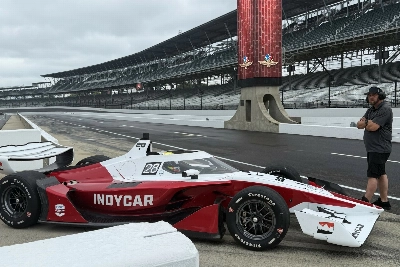
Alex Palou and Alexander Rossi were immediately impressed by the new IndyCar model after getting their first look at the vehicle. The pair became the inaugural test drivers for the IR-28, taking the car around the 14-turn, 2.439-mile road course at the Indianapolis Motor Speedway. Both drivers provided rave reviews following the shakedown sessions.
Palou, a four-time series champion, joked on Sunday about the prospect of racing the new car. “I am very happy to announce that we will race it next year,” he quipped, adding, “I wish (it was next year) – like that’s the level of excitement I think among everybody. When we saw it live for the first time, I was shocked at how good it looked and how excited I was to give it a try.”
Although Palou, who drives for Chip Ganassi Racing, would likely dominate in the new machine, the IR-28 is not scheduled for its competitive debut until 2028. The Spaniard, who has secured 21 victories in his last 64 races and is nearing a fourth consecutive series title, expressed a desire for the development process to accelerate. His interest was initially captured by the car’s sleeker, lighter, and jet-like aesthetic.
The new design features higher sidepods and expansive, wavier front wings that give the car a more substantial presence. A high-tech digital display, positioned behind a redesigned and less bulky aero-screen, provides real-time information on the car’s position during races, qualifying, or practice sessions. Designers aimed to improve the vehicle by offering a roomier cockpit, increased speed, and better racing capabilities, all while integrating enhanced safety features.
Alexander Rossi, the 2016 Indianapolis 500 winner, found the car exceeded his expectations. As one of the taller drivers in the series at 6-foot-1, Rossi appreciated the ergonomic improvements. “Not to draw comparisons to F1, we don’t like doing that, but I think anyone who drives an F1 car for the first time, they notice how smooth the car is – not from a powertrain standpoint but from the surface standpoint,” Rossi noted. “This car starts to get to that level. It’s a little bigger, certainly more room for me. My knees aren’t headed into the top of the chassis, which is great.”
The testing sessions were intended to establish baseline performance metrics rather than focus on top speeds, and no official data was recorded. The schedule was limited to three hours for Rossi on Saturday and three hours for Palou on Sunday. Unfortunately, cool and wet weather conditions in Indianapolis forced both drivers to cut their track time by at least half.
Despite the limited running, both drivers remained enthusiastic about their contribution to the sport’s future. “It’s pretty incredible to be able to be a part of the next evolution and to do it at a place that obviously means a lot to me and all of us here,” Rossi said. “It’s a small part to play in the history and the future of this championship, and that’s super cool.”
While the schedule for the next IR-28 test remains unconfirmed, Palou is eager for more drivers to get behind the wheel. “It’s super fun,” Palou remarked. “It’s just like being on a higher end car. It feels like one of those interiors that are like good leather and it’s quiet inside. It’s good, it’s comfy, so, yeah, I can’t wait to hopefully try it in the dry (conditions) and see how it really feels when I push it.” IndyCar action resumes next Sunday in Portland, Oregon.
The Spaniard who drives for Chip Ganassi Racing certainly would be leading the pack again if he actually competed in the IR-28 next year because it isn’t scheduled to debut until 2028.
Naturally, though, Palou, who has won 21 of the last 64 races including Indy in 2025 and is on the cusp of clinching a fourth straight series title, would prefer everything goes quicker.
He started seven Formula 1 races in four seasons before moving to IndyCars in 2016 and at 6-foot-1, Rossi is one of IndyCar’s tallest drivers.
But it’s not like you’re out there driving a Suburban.”
Still, it didn’t dampen the spirits of either driver.