Minister for Sport Andrea Abodi has declared that Italy’s role as a co-host for EURO 2032 will fundamentally transform the nation’s football landscape, supported by €4.5 billion in private infrastructure investment. Currently, many Italian stadiums rely on outdated structures originally built for the 1990 World Cup, necessitating constant, minor repairs rather than true modernization.
Co-hosting the 2032 European Championship alongside Turkiye is intended to establish firm deadlines, compelling authorities to finally prioritize the construction of modern, high-quality arenas. Officials confirmed that 13 cities and 16 stadiums are currently candidates for the tournament, though only five will ultimately be selected to host matches.
“As I have said over the last three and a half years, what’s happening with our stadiums has never been seen before in the history of our country,” stated Minister Abodi. “There are 13 cities, 16 projects, and €4.5 billion in private investment.”
The government is collaborating with the FIGC to reduce bureaucratic red tape, including the appointment of a dedicated commissioner to oversee stadium development. “The objective is to reach EURO 2032 with stadiums that are modern, welcoming, functional, accessible and sustainable, improving the cities that host them,” Abodi added.
By October, the FIGC will submit its final list of candidates and reserves to UEFA for the final selection process. Abodi emphasized that this initiative represents an epoch-making transformation for Italian football, supported by the government of Giorgia Meloni.
However, the list of 13 candidate cities has raised questions, notably excluding Bergamo and Udine, despite both cities possessing modern, well-prepared facilities. Conversely, the list includes three potential venues in Rome, even though two of those projects currently lack necessary planning permissions.
Other projects remain in early stages, including the proposed Cagliari stadium and the new arena intended to replace the San Siro for Inter and Milan. Palermo is viewed as a strong candidate, given the club’s ownership by the City Football Group and their stated desire to modernize infrastructure.
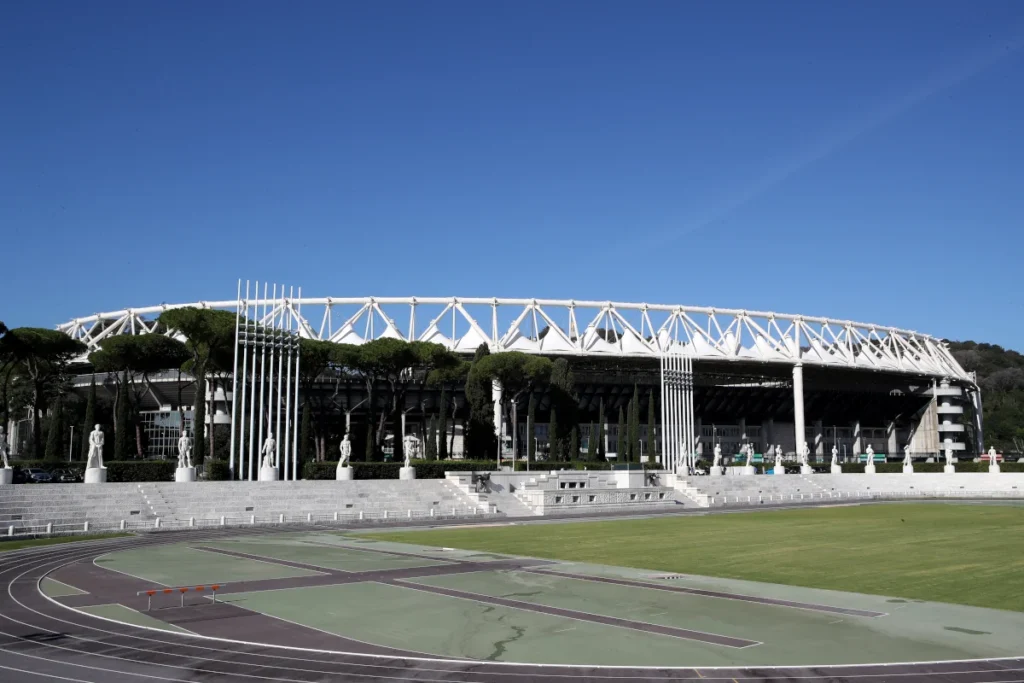
The full list of 16 candidate stadiums includes Bari’s Stadio San Nicola, Bologna’s Stadio Dall’Ara, the new Cagliari stadium, Florence’s Stadio Franchi, Genoa’s Stadio Ferraris, Lecce’s Stadio Giardiniero, the new Milan stadium, Naples’ Stadio Maradona, Palermo’s Stadio Barbera, Rome’s Stadio Olimpico, the new Roma stadium, Stadio Flaminio, Salerno’s Stadio Arechi, Juventus Stadium in Turin, and Verona’s Stadio Bentegodi.
Italy faces a critical need for high-quality, modern infrastructure. Failure to successfully execute these projects could relegate the nation to a second-tier footballing status, similar to the standing of countries like Czechia, Hungary, or Uruguay. Critics, meanwhile, remain wary, suggesting that the massive influx of capital could potentially invite increased corruption.
Too many Italian stadiums are still patching up and adding to the basic structures that were put in place when hosting the 1990 World Cup.
It is therefore hoped that co-hosting duties with Turkiye for the 2032 European Championship can help set deadlines forcing the authorities to make a genuine push for modern arenas.
More details are emerging on the list of 13 host cities presented, which oddly do not include Bergamo and Udine, who had two of the most modern and well-prepared stadiums already.
Only thing it will change is more corruption