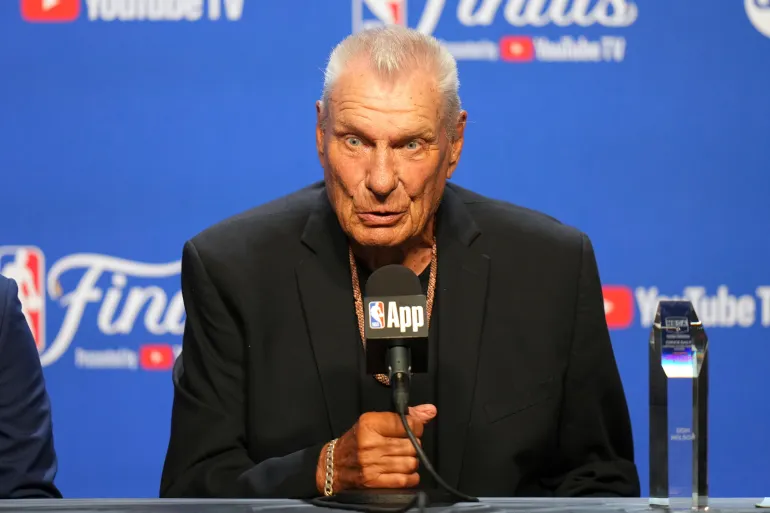
Don Nelson, a transformative figure in professional basketball who served as both a championship-winning player and a pioneering head coach, has died at the age of 86. His passing marks the end of a career that spanned nearly five decades, leaving an indelible impact on the sport’s tactical evolution.
The Nelson family confirmed his death in a statement, noting that he passed away peacefully on Sunday morning. “On Sunday morning our beloved husband, dad, grandfather and great-grandfather Don Nelson peacefully went to be with the Lord, surrounded by his loving family,” the statement read. “Throughout his last week, friends and family encircled him with love, sharing the blessing of his friendship and revisiting treasured memories.”
Nelson’s coaching legacy is defined by his record-breaking tenure and his tactical creativity. When he retired in 2010, he held the all-time record for regular-season coaching victories with 1,335 wins. While that record was later surpassed by San Antonio Spurs coach Gregg Popovich, who reached 1,390, Nelson’s influence remains profound. He was widely celebrated for his fast-paced offensive philosophy and the deployment of smaller, highly athletic lineups, a strategy that became affectionately known as “Nellie Ball.”
Over a 31-year coaching career, Nelson led the Milwaukee Bucks, Golden State Warriors, New York Knicks, and Dallas Mavericks. Although he never secured an NBA title as a head coach, he was a three-time Coach of the Year and achieved 13 seasons with at least 50 victories, including two 60-win campaigns. The Golden State Warriors organization praised his vision, stating, “[Nelson] was a true basketball visionary who saw the game differently and was never afraid to challenge conventional thinking. His approach helped shape the game and paved the way for generations of players and coaches who followed.”
One of his most significant contributions occurred during his time with the Dallas Mavericks, where he played a pivotal role in the development of Dirk Nowitzki. Recognizing the potential of the German prospect, Nelson helped integrate Nowitzki into the NBA, granting him the freedom to evolve into a Hall of Fame talent. Reflecting on their relationship, Nowitzki posted on social media, “Nellie… You believed in me. You saw things in my game before I ever realized I could do them. I’ve said it a million times and I will always say it: I don’t think my career could have turned out how it did without you being my first coach and giving me the freedom to play my game. I can only say THANK YOU. For everything.”
Before his coaching success, Nelson enjoyed a distinguished career as a player. He won five NBA championships during his 11 seasons with the Boston Celtics, who honored his contributions by retiring his number 19 jersey in 1978. His professional journey began as the third overall pick in the 1962 draft by the Chicago Zephyrs, followed by a two-year stint with the Los Angeles Lakers before he joined the legendary Celtics roster.
Nelson’s collegiate career at the University of Iowa was equally impressive, where he averaged 21.1 points and 10.9 rebounds over 72 games. His transition to the professional ranks saw him become a key contributor to Boston’s success, averaging 11.1 points and 4.8 rebounds across 134 career playoff games. In 2012, he was formally inducted into the Naismith Memorial Basketball Hall of Fame as a coach, and in 2025, he received the Chuck Daly Lifetime Achievement Award.
NBA Commissioner Adam Silver paid tribute to Nelson’s enduring legacy, stating, “Don Nelson revolutionized NBA basketball through his fearlessness, ingenuity and deep conviction. He spent nearly 50 years in the NBA – winning five championships as a player with the Boston Celtics before building one of the most successful and pioneering coaching careers in league history. He brought an unmistakable personality to everything he did, and his impact on our sport will continue to be felt for generations.”
Silver concluded his remarks by extending his condolences to Nelson’s family and the wider basketball community. As the league mourns, the consensus remains that Nelson’s authenticity, passion, and willingness to challenge the status quo fundamentally altered the trajectory of professional basketball, ensuring his influence will be studied and felt for years to come.
The three-time Coach of the Year didn’t win any NBA titles during his 31-year overall tenure with the Milwaukee Bucks (1976-87), Golden State Warriors (1988-95, 2006-10), New York Knicks (1995-96) and Dallas Mavericks (