
Tensions surrounding the Spanish enclave of Ceuta have spilled into the world of professional football, creating a heated debate over how players and clubs engage with a humanitarian crisis. During a recent Madrid derby, fans at the Metropolitano Stadium displayed a banner declaring: “Ceuta es Espana. Ni se arruga, ni se tapa,” roughly translating to “Ceuta is Spain. It is neither rolled up, nor covered.” The message served as a direct rebuke of high-profile players like Kylian Mbappe, Vinicius Junior, and Ibrahima Konate, who had been seen modifying shirts during a match against Elche to signal solidarity with the enclave.
The backdrop to this conflict is an unprecedented influx of people at the border. In late July, a record 72,000 migrants crossed from Morocco into Ceuta within just two days, overwhelming local infrastructure. The human cost was severe, with the NGO Caminando Fronteras recording 141 deaths across both sides of the border following the mass movement.
The solidarity campaign, initiated on September 11 by the non-profit Asociacion Valenciana de Empresarios (AVE), aimed to express support for Ceuta’s residents and businesses. AVE is led by Vicente Boluda, a former interim Real Madrid president whose business interests include maritime operations in the region. While Real Madrid stated it respected its players’ freedom to participate, the response was not universal. Barcelona notably declined to wear the shirts, and La Liga president Javier Tebas publicly criticized the participating Real Madrid players, arguing that the gesture carried political implications. Meanwhile, AFE union head David Aganzo suggested that players should be better informed about the initiatives they are asked to support.
For players like Mbappe and Konate, who both have strong ancestral ties to the African continent, the gesture was complex. Mbappe clarified that his actions were not intended as a slight against Ceuta, but rather as an acknowledgment of suffering on all sides. “I also wanted to think about all the people who are suffering, because in the end I am human and I don’t want to prioritise the suffering of one group over another,” he explained, adding that he wanted to recognize those who lost their lives during the crisis.
The situation has left local officials in a difficult position. Luhay Hamido, president of AD Ceuta, noted that the club has suffered direct consequences, including the collapse of several player signings as families grew fearful after watching news coverage of the border situation. Despite these challenges, Hamido described the broader support from the Spanish football community as “pure fuel” that provides the city with essential hope. Regarding the controversy, he emphasized that players should not be forced into ideological stances they may not fully grasp, telling reporters, “[These] people, in the end, are not to blame.”
Quantifying the crisis has proven difficult as conditions fluctuate. While the Spanish Interior Ministry reported that over 70,000 people returned to Morocco shortly after the initial surge, the situation remains dire. Government estimates from seven weeks later suggested between 9,000 and 10,000 migrants remained in the enclave. More recent figures from September 20 indicate that approximately 8,300 people were being housed in various facilities, while over 4,000 individuals were still living on the streets. A new temporary port facility, designed to hold 1,700 people, reached its capacity within hours of becoming operational.
The political friction has often obscured the reality on the ground, where Moroccan journalist Youssef Temsamani has criticized media and political rhetoric that labels the movement of people an “invasion.” Even within the stadiums, the issue remains a flashpoint; during the Madrid derby, supporters briefly united to chant “Ceuta no se vende, Ceuta se defiende” (Ceuta is not for sale, Ceuta must be defended), yet Mbappe and Vinicius still faced jeers from sections of the crowd.
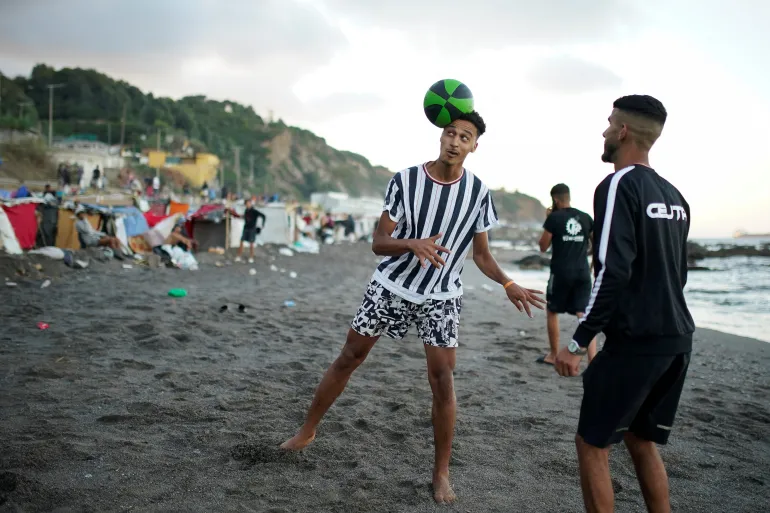
Away from the political discourse, the reality of the border crisis is visible in the streets of Ceuta, where children play football against makeshift walls in makeshift kits. For observers like Hamido, the focus on grand political gestures risks ignoring the humanity of those caught in the middle of a geopolitical standoff, reinforcing the need for a more nuanced perspective on both the city’s status and the people arriving at its borders. The report also notes that while France captain Mbappe grew up in Bondy, outside Paris, to parents who came from Cameroon and Algeria, konate was born and raised in Paris by parents who migrated from Mali. The report also notes that mbappe and Vinicius were also the target of whistles from both sets of fans when Real’s starting XI was announced prior to kickoff. The report also notes that jorge Garcia, a 32-year-old Atletico Madrid supporter, believed they deserved the jeering. The report also notes that declaring: “This is Spain, this is Ceuta, spain coach Luis de la Fuente travelled to Ceuta with the World Cup trophy. The report also notes that a Spain-based Moroccan journalist, believes the players found themselves in a difficult position: wearing the shirt could be interpreted as taking a political position, but declining to do so could be portrayed as showing a lack of solidarity, youssef Temsamani. The report also notes that “We cannot force anyone to identify with a cause they do not understand,” he told, suggesting footballers are sometimes simply told to put on a shirt in the tunnel without having received a full explanation. The report also notes that spain’s Interior Ministry put the number of people who irregularly crossed into Ceuta on July 30 and 31 at 72,000, saying more than 70,000 initially returned to Morocco. The report also notes that the club began paying for prospective signings to visit the city before making their decision.
