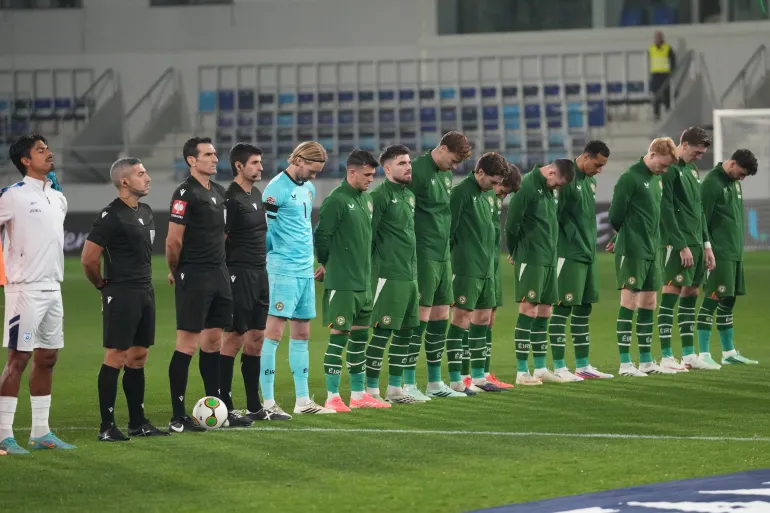
During their recent UEFA Nations League fixture on Sunday, Republic of Ireland players once again donned black armbands in tribute to Palestinians killed in Gaza. The squad maintained a somber tone, bowing their heads during the Israeli national anthem before the match commenced in Backa Topola, Serbia.
The League 3 Group B contest ended in a 1-1 draw and was played behind closed doors on neutral ground. Despite the lack of spectators, the atmosphere remained confrontational. Stand-in captain Caoimhin Kelleher, replacing Dara O’Shea who was absent for the birth of his child, declined to shake hands with Israeli captain Dor Peretz, mirroring an action taken by O’Shea during the previous meeting in Debrecen, Hungary. Ireland had won that earlier match 3-0. Ireland went on to win that game 3-0 through three first-half goals.
Troy Parrott opened the scoring for Ireland with a 39th-minute penalty following a foul by Peretz on Jimmy Dunne. However, Peretz leveled the score with a close-range effort in the 47th minute. Tensions flared briefly as players departed for halftime, prompting referee intervention. Notably, Israel forward Sayed Abu Farchi returned to the squad after serving a suspension for a controversial goal celebration during a match against Austria on September 25.
The Football Association of Ireland (FAI) originally scheduled the match for Dublin but relocated it to a neutral venue in June citing operational reasons, following intense pressure to boycott the event. The FAI had previously lobbied UEFA to suspend Israel from international competition. Despite this, only reserve goalkeeper Gavin Bazunu withdrew from the fixtures, citing a personal moral objection to the ongoing conflict. More than 160 Irish sportspeople had signed an open letter calling for a full team boycott, and protesters gathered at the team’s hotel in Dublin to urge players to withdraw. Ultimately, only reserve goalkeeper Gavin Bazunu decided to skip both of the contentious games, saying in a statement that it was his “personal belief that the killing of innocent people is wrong”. The SIPTU trade union displayed a huge poster in central Dublin beside the River Liffey asking the players to “Go with your conscience!” and “Don’t play with genocide” beside an image of a blood-splattered ball.
Coach Heimir Hallgrimsson previously acknowledged the significant strain on the players, stating the pressure was reaching a breaking point. Ahead of the first match, the team held a marathon deliberative session, reportedly voting 14-8 in favor of continuing play after Bazunu’s departure. The decision faced sharp criticism from former manager Brian Kerr, who stated the FAI had lost public respect by proceeding with the games, especially with Ireland set to cohost the 2028 European Championship alongside England, Wales, and Scotland. According to “I felt that pressure growing day by day, and it’s getting almost to a breaking limit now,” Ireland coach Heimir Hallgrimsson, At the time. They reportedly voted 14-8 in favour of continuing after Bazunu’s withdrawal that morning.
Off-field friction persisted throughout the week. On Thursday, during Ireland’s draw with Austria, protesters threw tennis balls marked with Palestinian flags onto the pitch. By Saturday, diplomatic tensions surfaced when an Israeli journalist alleged at a press conference that Irish players had used derogatory language toward their opponents during the previous week’s game. Irish communications officer Kieran Crowley immediately rebuffed the claim as a lie and terminated the session. Finn Azaz, whose mother has Israeli heritage, was among the Irish substitutes after playing from the start against Austria on Thursday. Although the referee quickly intervened, a disagreement also broke out on the sidelines as the players made their way off the field for the interval. Protesters threw tennis balls with Palestinian flags onto the field during Ireland’s 2-2 draw with Austria on Thursday.
Broadcasting of the fixtures reflected the sensitivity of the situation. Ireland’s national broadcaster, RTÉ, stripped back its coverage, opting for no studio analysis or commentary and refusing to accept advertising or sponsorship for the games. The network also confirmed that Ireland will skip the Eurovision Song Contest for a second consecutive year due to Israel’s participation in the event.