Police in the Croatian city of Split have confirmed the arrest of 12 Hajduk Split football fans following a disturbing series of events surrounding Thursday’s UEFA Conference League match against the Dutch club Ajax. The arrests occurred on Friday as officials investigated charges of inciting hatred and violence, with law enforcement indicating that additional suspects could be detained as the investigation proceeds.
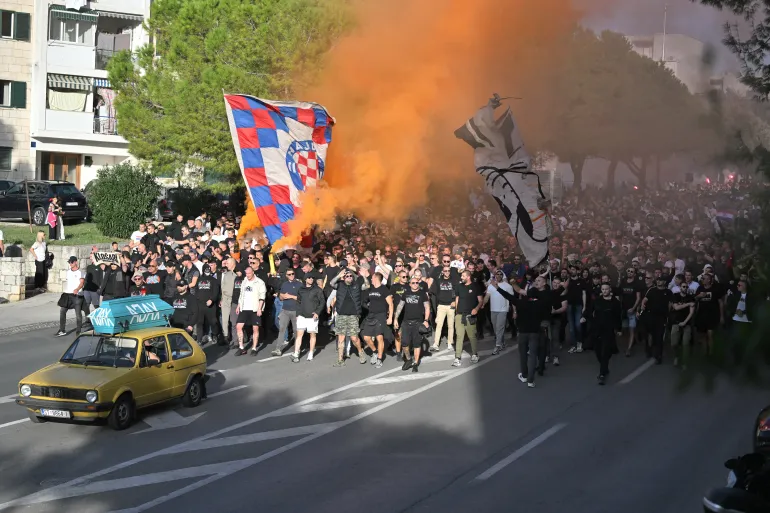
The incident escalated before the match when thousands of supporters held an anti-Semitic demonstration. Fans were seen marching behind a vehicle carrying a mock-up coffin adorned with the Ajax team name, an organization long associated with Amsterdam’s Jewish community. During this rally, participants shouted slurs against Jewish people and chanted in support of Nazi leader Adolf Hitler.
Tensions continued inside the stadium, where supporters threw flares and various objects onto the pitch, forcing a 12-minute interruption to the match. Despite the chaos, Hajduk Split secured a 2-1 victory, marking the team’s first major European competition match in 16 years. The club now faces potential disciplinary action from UEFA. According to the Hajduk Split team, which could face disciplinary action from UEFA over the game’s disruption, apologised for the fans’ behaviour but, It reflected only some of the club’s fans.
Responding to the events, the Hajduk Split management issued an apology, acknowledging that the behavior was embarrassing while distancing the club from the actions of those specific fans. A statement from the team noted, “Despite all efforts, things happened that we are not proud of, but we are ready to take the consequences as a club.”
The events triggered sharp condemnation from high-level officials and organizations. Croatian President Zoran Milanovic called for immediate sanctions, asserting that there is “no place for glorification of Nazism in Croatia.” The Croatian Football Association also denounced the actions, stating that the conduct was entirely contrary to “the basic values of sports: mutual respect, tolerance and togetherness,” and damaged the nation’s sporting reputation. The outburst drew widespread condemnation in Croatia.
International and local reactions were swift, with the Israeli embassy in Zagreb stating it was “deeply shocked” by the demonstration and demanding government intervention. Milorad Pupovac, leader of the ethnic Serb minority in Croatia—a group that suffered significantly under the country’s World War II pro-Nazi regime—commented that it was “just a question of time” before such an incident occurred.
The episode has reignited broader national debates regarding nationalist sentiments in Croatia. While critics argue the government often ignores far-right activities linked to the country’s World War II regime—a history involving the deaths of tens of thousands of Serbs, Jews, Roma, and anti-fascist Croats in concentration camps—the government has consistently denied these claims.