
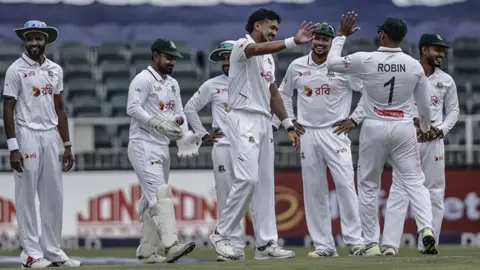
Bangladesh cricket is currently grappling with a severe shortage of world-class expertise, particularly in pace bowling and fielding coaching. Recent performances have been marred by sloppy fielding, evidenced by dropped catches in the lone Test against Afghanistan in Abu Dhabi that effectively cost the team a win. This trend of missed opportunities has persisted through the home series against the West Indies and continued into the ongoing Johannesburg Test, where multiple catches have already gone down. In the high-stakes environment of Test cricket, these lapses are often the difference between success and failure.
The void in the fielding coaching department has created significant uncertainty. James Pamment, who was appointed in April 2025 with a contract extending through the 2027 World Cup, has struggled to fulfill his duties consistently due to injury. Indications suggest the Bangladesh Cricket Board (BCB) is looking to part ways with him. While former cricketer Ashikur Rahman Majumdar has been serving in an interim capacity since the home series against Pakistan, his responsibilities have been diverted to the ‘A’ team for the South Africa tour. Consequently, assistant coach Malibongwe Maketa has been overseeing the national team’s fielding, raising concerns about the long-term sustainability of these makeshift arrangements for the Test side.
A similar crisis plagues the pace bowling unit. Since Shaun Tait stepped down in June, the attack has lacked clear direction. Under Tait’s guidance, the team achieved a landmark 2-0 Test series victory over Pakistan. Currently, former pacer Talha Jubayer is managing the pace bowlers. Beyond just technical instruction, a coach is vital for devising plans, managing workload, assessing player fitness, and reading pitch conditions—all areas where the team now appears to be struggling.
Physical conditioning and injuries are compounding these tactical issues. Pace sensation Nahid Rana has been sidelined frequently, missing the tour of Australia, the Afghanistan Test, and the West Indies series due to a side strain, glute injury, and labrum tear. Meanwhile, concerns over Hasan Mahmud’s fitness persist; he has been managing tennis elbow since the Abu Dhabi Test, where he bowled 47 overs across two innings. Even during the current South Africa series, he required additional bandaging on his right hand to continue bowling.
The overall fitness of the pace battery remains a major talking point. Taskin Ahmed’s speed has noticeably declined, with signs of fatigue appearing during long spells. Ebadot Hossain, who once consistently clocked speeds over 140 km/h, now struggles to stay above 130 km/h. Other bowlers like Shoriful Islam and Khaled Ahmed are often sidelined, largely due to team balance issues rather than rotation strategies. Currently, the burden of the attack seems to rest heavily on Hasan Mahmud, which is far from an ideal strategic setup.
In the current Test, Bangladesh is operating with only four primary bowlers—three pacers and one specialist spinner, Mehidy Hasan Miraz. This limited pool complicates workload management. In contrast, South Africa has employed a more balanced four-pacer, one-spinner combination. The inability to consistently claim 20 wickets remains the primary barrier to winning Tests. Despite a historic win in Darwin, the bowling unit has struggled to dismantle opposition lineups. Even in the draw against Afghanistan, where the team failed to take the final two wickets despite the opponents batting for 142 overs, captain Najmul Hossain Shanto admitted the team underperformed.
While advocating for local coaches is reasonable, the national board must first establish the necessary infrastructure to support them. India’s success, for instance, is built on decades of investment, such as the MRF Pace Foundation established in 1987, alongside a robust domestic structure and a culture of excellence. Bangladesh is still far from that level of systemic development. To maintain the progress made in recent years, the team must urgently address these coaching and planning deficiencies; in cricket, as in life, failing to prepare for looming challenges often comes with a steep price.