In the 1960s, few athletes transformed their sport as profoundly as Peggy Fleming. Her journey to the 1968 Winter Olympics in Grenoble was defined not just by athletic prowess, but by the immense pressure of carrying a nation’s hopes after a catastrophic loss that nearly destroyed the future of American figure skating.
On February 14, 1961, the entire US figure skating team boarded Sabena Flight 548, traveling from New York to Prague, Czechoslovakia, for the World Figure Skating Championships. The Boeing 707 crashed while attempting to land at Brussels Airport, killing everyone on board. The tragedy claimed the lives of 18 promising skaters, along with 16 others, including officials, judges, and coaches—among them Fleming’s own mentor, Bill Kipp. USA Today sports columnist Christine Brennan noted that the loss effectively wiped out the program’s stars for the 1962, 1963, and 1964 seasons.
With the program decimated, the burden of rebuilding fell on a young Fleming. As Brennan observed, the pressure was immense because there were few others left to carry the mantle. The recovery process involved bringing in international expertise, most notably Italian coach Carlo Fassi, who became instrumental in Fleming’s development. While she competed at the 1964 Winter Olympics at age 15, it was considered a premature experience. However, she soon dominated the sport, securing five consecutive national titles and back-to-back world championships.
By the 1968 Games, Fleming was the undisputed leader of the sport. The pressure in Grenoble was twofold: she was competing for a nation desperate for gold and honoring the legacy of the 18 skaters and her former coach who never reached their potential. As Fleming herself noted, the sport is uniquely isolating, with no teammates or protective gear to hide behind—just the individual on the ice.
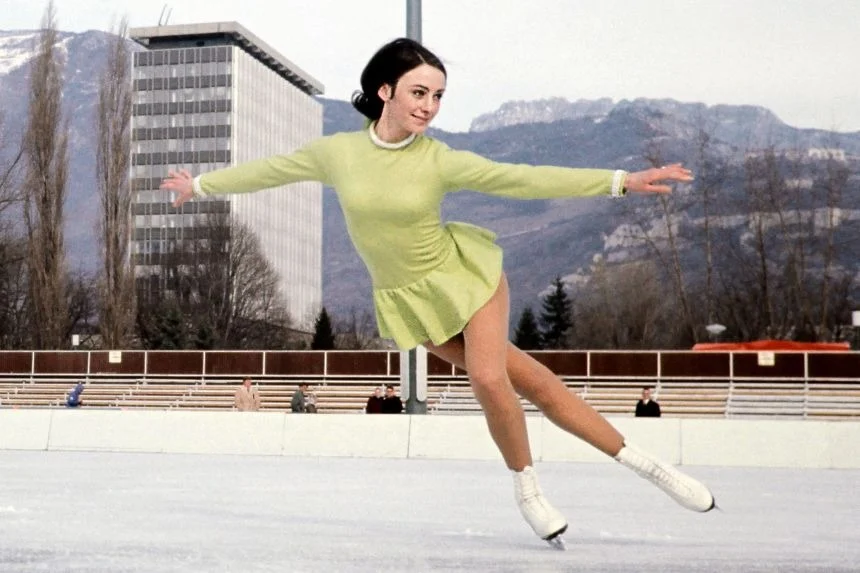
Fleming’s performance in Grenoble was a triumph, earning the United States its only gold medal of those Games. Her grace was captured on color television, which was becoming increasingly common in American households. The iconic chartreuse dress she wore, chosen by her mother to honor the history of the French host city, became a symbol of a cultural watershed moment. As Kathrine Switzer, the first official female entrant to the Boston Marathon, described it, Fleming performed with a “grace and serenity that was almost goddess-like.”
The story of Peggy Fleming remains a testament to resilience, marking the transition from a national tragedy to ultimate sporting success. Her ability to rise from the ashes of the 1961 disaster and capture the hearts of millions solidified her legacy as a transformative figure in American sports history.
This narrative is explored further in the Original Series “Decades in Sports,” which examines the cultural shifts and defining moments that shaped athletics over the past sixty years, from the television revolution of the 1960s to the modern era of social media. The report also notes that this is the burden a 19-year-old Fleming had to carry heading into the 1968 Winter Olympics in Grenoble. The report also notes that rewind seven years prior to February 14, 1961, and the US figure skating team was boarding Sabena Flight 548 from New York bound for Brussels, with their final destination being Prague, Czechoslovakia, where the World Fi. The report also notes that but tragically, the team never got the chance, as the Boeing 707 operating the flight crashed on approach to Brussel, they were looking to defend the world title Carol Heiss had won for a fifth straight time a year prior. The report also notes that heading into an Olympic Games with the hopes of a nation on their shoulders is a heavy burden to carry, for any athlete. The report also notes that and it’s an entirely different proposition altogether, add to that a devastating tragedy that takes the lives of almost all of their contemporaries. The report also notes that but tragically, the team never got the chance, as the Boeing 707 operating the flight crashed on approach to Brussels Airport and killed the entire US figure skating team, they were looking to defend the world title Carol Heiss had won for a fifth straight time a year prior. The report also notes that and as USA Today sports columnist Christine Brennan highlights in the series: “All the young women who would have been the stars in ’62, ’63 and ’64 (were) gone.”, uS figure skating was decimated overnight. The report also notes that attention quickly turns to how US figure skating would rebuild and maintain the dominance it enjoyed throughout the 1950s, after the tragedy.