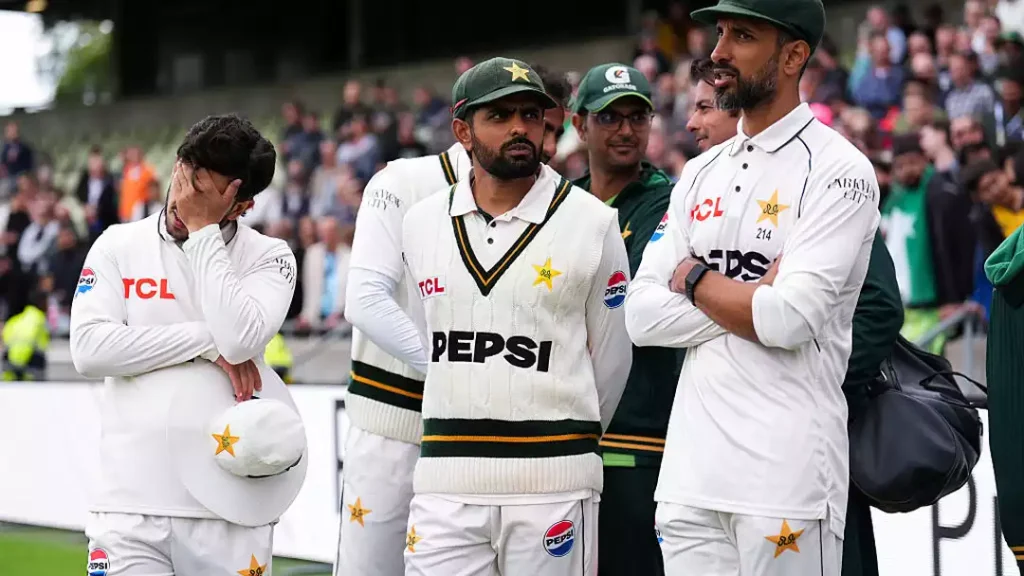
Pakistan’s Test cricket program is currently grappling with a systemic crisis that extends far beyond recent individual performances. The team’s struggles were laid bare during their 2026 England tour, where they suffered a 3-0 series whitewash, losing by an innings and 103 runs, 194 runs, and eight wickets respectively. This result marked the second time England has swept Pakistan in a series since the 2022/23 campaign. Statistically, this is Pakistan’s 11th series loss by a 0-3 margin and their ninth such defeat in a three-Test series during the 21st century—the highest total among all international teams, surpassing Sri Lanka’s five.
This downturn is part of a broader pattern of inconsistency that has plagued the side since August 2021, the beginning of the second World Test Championship (WTC) cycle. Over the past 37 Tests, the team has managed to field an unchanged XI on only three occasions: against Bangladesh in Dhaka (2021), Sri Lanka in Colombo (2023), and England in Rawalpindi (2024). This constant rotation has forced Pakistan to utilize 43 different players over those 37 matches, introducing 32 new faces after the initial lineup, a turnover rate of 0.89 new players per Test. Among WTC participants, only South Africa has demonstrated a higher rotation rate, though that was largely attributed to fielding a second-string squad in New Zealand due to SA20 scheduling conflicts.
The instability is not limited to the players. The coaching landscape has been equally volatile, beginning with the resignations of Misbah-ul-Haq and Waqar Younis in September 2021. The subsequent tenure saw rapid turnover with coaches including Saqlain Mushtaq, Grant Bradburn, Mickey Arthur, and Mohammad Hafeez. Most recently, the Pakistan Cricket Board (PCB) dismissed head coach Sarfaraz Ahmed and his bowling staff following the team’s defeats at Leeds and Lord’s, marking yet another major staff overhaul.
Pakistan’s standing in the World Test Championship reflects this downward trajectory. They placed seventh in the 2021-23 cycle with a 38.1% points percentage, dropped to ninth in the 2023-25 cycle at 27.98%, and currently occupy the bottom of the table. Their overall win-loss ratio in this period stands at 0.5, the second-worst among all WTC teams, trailing only the West Indies (0.4). Furthermore, their global Test win-loss ratio has dipped below 1.0 for the first time in an extensive period.
Home dominance, once a hallmark of Pakistan’s cricket, has faded significantly. While teams like Australia, South Africa, and India have maintained strong win-loss ratios at home, Pakistan has struggled to leverage local conditions. Their away record is even more challenging; since August 2021, they have secured only seven wins against 13 losses in 20 matches. Notably, they remain winless in their last 19 Tests in SENA countries—losing 17 and drawing two—with their last victory in those conditions occurring at Lord’s back in May 2018.
Batting inconsistency has severely hampered their ability to compete. Since the 2021-23 WTC cycle began, Pakistan has been bowled out for under 250 runs in 32 separate innings, with 18 of those totals falling below 200. During the recent series, the team was dismissed for under 200 in five consecutive innings. Their combined batting average of 28.46 ranks sixth among the nine WTC teams, with no batter averaging above 45 despite seven individuals scoring over 1000 runs in this timeframe. Babar Azam leads the scoring with 2602 runs at 43.4, followed by Shan Masood, who has recorded 1548 runs at 32.25.
The team’s reliance on bowling has also shifted. Historically, Pakistan’s success was rooted in elite pace bowling, yet current stats show their pacers have taken 305 wickets at an average of 32.7, the second-worst average in the WTC since 2021. Conversely, the team has found sporadic success through spin, which accounted for 144 wickets at an average of 20.17 during their 11 victories in this period. However, in their 22 defeats, spinners managed just 110 wickets at a significantly higher average of 43.8.
Despite the high turnover, no individual specialist bowler has played more than 18 of the last 37 Tests, with Noman Ali holding that highest count. Shaheen Afridi has been limited to 17 appearances among the pacers. These figures highlight a lack of continuity that complicates long-term strategy, leaving the national side searching for a stable identity amidst a period of prolonged underperformance. The report also notes that the latest episode is particularly Bleak. The report also notes that their sixth whitewash in 12 multi-Test series over the last four years, and their ninth 0-3 loss in a three-Test series in the 21st century – the most by any team, ahead of Sri Lanka (five), it was Pakistan’s 11th series loss by a 0-3 margin. The report also notes that with former Test coach Jason Gillespie’s criticism of frequent U-turns raising questions about selection, consistency and long-term planning, the moves have put Pakistan cricket under fresh scrutiny. The report also notes that especially in Tests and major tournaments, the numbers suggest a deeper problem: a team capable of individual brilliance but struggling to turn it into sustained success. The report also notes that they introduced 32 more across the next 36 matches – 0.89 new players per Test, after the first 11 players. The report also notes that only South Africa has a higher turnover, largely due to the second-string side they fielded in New Zealand in 2023-24 because of SA20 league, among WTC teams. The report also notes that babar Azam played 33, Rizwan 32 and Salman Agha played 28 games each. The report also notes that only South Africa (26), England (24) have more in this regard.