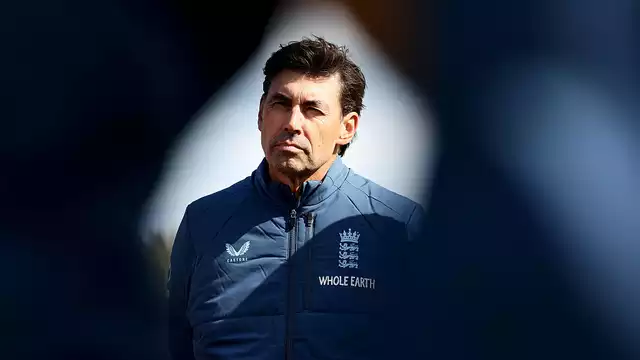
Stephen Fleming, England’s newly appointed Test head coach, has outlined a vision to bridge the gap between domestic county cricket and the international Test setup.
As he prepares to lead the team for his inaugural series in South Africa later this year, Fleming emphasized his intention to foster a more inclusive environment that leverages local coaching talent and former players. He explicitly stated a preference for the national team to be overseen by an English coach in the future, a notable stance given that since 1999, the Test side has been led by only two English coaches—Peter Moores and Chris Silverwood—alongside Ashley Giles’s stint as a white-ball coach.
The coaching hierarchy is already reflecting this new direction. Fleming’s staff includes several former England players such as Marcus Trescothick, who acted as interim Test coach against Pakistan earlier this year, along with former wicketkeeper James Foster and ex-spinner Richard Dawson. Additionally, Jonathan Trott, a veteran of England’s Ashes-winning squads, has been appointed to lead the England Lions. Fleming expressed gratitude for these opportunities, noting that while the core coaching team is established, he plans to evolve the structure by introducing county coaches and past players at various stages to support the national squad. Meanwhile, Jonathan Trott, who was part of England’s Ashes-winning side, is set to take charge of England Lions. “I’m grateful for the opportunity, but there will be some development in terms of the coaching, and you can see by our staff,” Fleming told BBC Radio 5 Live. But it is a real focus and it’s an ambition as well that you will also get county coaches who will be introduced at certain times and you will get past players that will be asked to come back as well, i look forward to working with them. Among Fleming’s immediate responsibilities is to figure out a roadmap for the spinner’s role in the Test side.
Fleming intends to cultivate an inclusive culture that maximizes domestic expertise. By integrating county perspectives, he hopes to drive a cohesive approach across the English game. This strategy marks a departure from the tenure of Brendon McCullum, whose engagement with the domestic circuit faced scrutiny, particularly during periods where he took extended breaks away from the team. Conversely, Fleming demonstrated his commitment by visiting multiple counties this past September and confirmed his plans to observe the domestic competition extensively ahead of the upcoming home Ashes series. But also driving what should be driven within the county game and the English game, it’s really inclusive and a comfortable nature of using what’s around. According to yep, I’ll be around and I really enjoyed this year getting to catch up,”, Fleming. “A lot of the guys I played with are now in positions either coaching or the head positions at counties.
Addressing the squad’s composition, Fleming is currently focused on establishing a definitive strategy for the spin-bowling department. This challenge comes after England opted for a four-seamer attack in all three Tests against Pakistan, and amidst wider debates on selection, highlighted by Australia’s choice to drop Nathan Lyon—a bowler with 573 Test wickets—for their recent Test against South Africa in Gqeberha. Within the current contract structure, Shoaib Bashir stands as the primary red-ball specialist, while Mason Crane and Liam Patterson-White have been granted development deals. Despite the off-spinner having taken 573 Test wickets, the selection debate has also been brought into focus by Australia’s decision to leave Nathan Lyon out of the ongoing Test against South Africa in Gqeberha.
Fleming described Bashir’s selection as a reflection of continuity, yet clarified that the path remains open for other candidates. He acknowledged that a deep pool of spinners is emerging within the domestic game, specifically noting that conditions in locations like Bangladesh could necessitate different tactical selections. Emphasizing a horses-for-courses approach, Fleming indicated that the side will remain adaptable. He continues to search for the right spin combination, balancing the development of younger talent like the experienced Bashir with the need for immediate, venue-specific performance across the Test cycle.