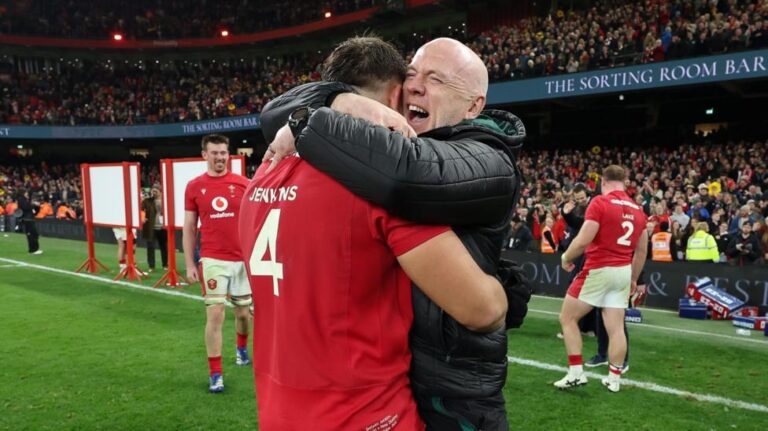
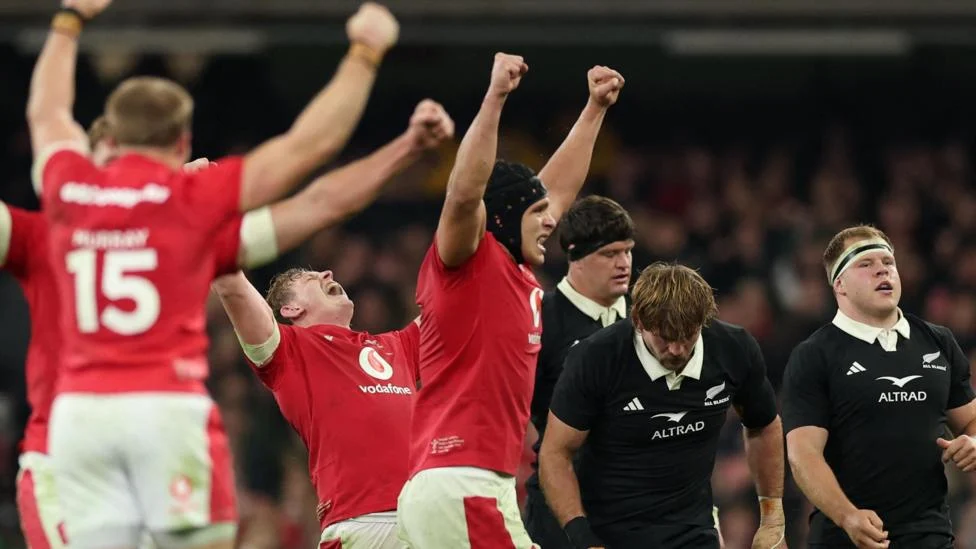
Wales achieved a historic milestone in Cardiff, defeating New Zealand 35-28 to secure their first victory against the All Blacks in 73 years. This Nations Championship thriller at the Principality Stadium saw Steve Tandy’s side break a 34-match losing sequence that had stretched back to 1953, the last time Wales had managed a win in this fixture. Wales had won the first three games in this fixture in 1905, 1935 and 1953 but have had to wait more than seven decades for the next. This was one of the finest performances in Welsh rugby history and a world apart from the display in the 28-21 win against Japan last weekend. Fast start for Wales as hosts dare to dream. With Taine Basham making his first Test start in four years by replacing injured number eight Aaron Wainwright, wales made four changes to the side that beat Japan. With full-back Beauden Barrett handed the Test captaincy for the first time in his 149th international, new Zealand made eight starting swaps from the team that beat Scotland 43-21. New Zealand’s haka was the usual piece of theatre as the All Blacks were lit up by a spotlight and Wales in red. This was the time we assumed the script would follow the familiar tale of New Zealand pulling away. Tapping reserves of strength, discipline and concentration to repel that black wave, wales dug deep once more. Reducing players and fans alike to tears of joy, the final whistle delivered the win this side and nation have deserved for so long.
Match Scoring Summary
- Wales (21) 35: Tries from T. Williams, Lake, Griffin, James, and Rees-Zammit; Conversions by Costelow (5)
- New Zealand (21) 28: Tries from Ratima, Sititi, Fineanganofo, and Lakai; Conversions by Mo’unga (4)
Match Personnel
- Wales: Murray; Rees-Zammit, E. James, Llewellyn, Hamer-Webb; Costelow, T. Williams; N. Smith, Lake (capt), Griffin, D. Jenkins, Beard, Botham, Morgan, Basham. Replacements: Elias, G. Thomas, D. Lewis, Carter, Plumtree, Morgan-Williams, Edwards, Hennessey.
- New Zealand: B. Barrett (capt); Fineanganofo, Tupaea, Lienert-Brown, Moorby; Mo’unga, Ratima; Bower, Aumua, Newell, S. Barrett, Lord, Segner, Lakai, Sititi. Replacements: Bell, Numia, Tosi, Hannah, E. Blackadder, Fainga’anuku, Preston, R. Ioane.
Match Officials
- Referee: Pierre Brousset (France)
- Assistant Referees: Nic Berry (Australia) and Luc Ramos (France)
- Television Match Official: Tual Trainini (France)
- Foul Play Review Officer: Leo Colgan (IRFU)
The home side established an early momentum, leading 14-0 and 21-7 before heading into halftime level at 21-21. Wales’s offensive intensity, highlighted by tries from Tomos Williams and captain Dewi Lake, initially stunned the visitors. Prop Archie Griffin contributed a first-half score, but New Zealand mounted a comeback with tries from Cortez Ratima, Wallace Sititi, and Fehi Fineanganofo. Wales followed this up with a well-worked forward move and captain Lake latched onto a flat Williams pass to crash over. New Zealand’s defence kept Wales at bay with some important turnovers before a breathless period of play followed with both sides throwing wild passes.
In the second half, Eddie James and Louis Rees-Zammit extended the Welsh lead to 35-21. A disciplined defensive stand followed, with Wales holding up the All Blacks over the try line on three separate occasions to preserve their advantage during the final quarter. The defensive effort, led by flankers James Botham and Jac Morgan alongside lock Dafydd Jenkins, ultimately sealed the outcome. A pair of scores inside eight minutes in the second.
Reflecting on the match, the triumph holds immense historical weight.
In 1953, when Wales last beat New Zealand, the New Zealand dollar did not exist, and Cardiff had not yet been named the capital city of Wales.
Furthermore, tries at that time were only worth three points.
Despite sections of the New Zealand media dismissing Wales’s chances and bookmakers offering long odds of 20-1, Tandy’s class of 2026 successfully carved out a new legacy. Now Tandy’s class of 2026 have written their own chapter in Welsh rugby’s history.
The match was attended by 55,152 spectators, the lowest crowd for this specific fixture at the Principality Stadium in recent years.
The atmosphere was electric, particularly as the home crowd realized a 14-point lead was within reach.
Despite a late push from New Zealand, who opted for a line-out over a scrum to capitalize on their size, Wales held firm. The fans who stayed away will regret it because it was a day to say “I was there”.
Key late-game contributions included two vital turnovers from replacement Taine Plumtree and composed management from half-backs Dan Edwards and Reuben Morgan-Williams. With Ospreys duo Dan Edwards and Reuben Morgan-Williams tasked to see out the final 16 minutes, replacement Wales eight Taine Plumtree gained two important turnovers before Tandy decided to take off his half-backs Williams and Costelow.
This performance stands as a defining moment in Welsh rugby, signaling a potential shift for a team that has faced significant challenges on and off the field. While New Zealand may rue missed opportunities—having failed to capitalize on France’s earlier victory over South Africa—the night belonged to the hosts who broke a 35-match wait for a win against the All Blacks. Legends such as Sir Gareth Edwards, Alun Wyn Jones, Shane Williams, JPR Williams, Barry John and Phil Bennett had never enjoyed success against New Zealand in a Welsh jersey. Who New Zealand coach Dave Rennie had highlighted as a pre-match dangerman, pounced for the try, the wing chipped ahead and Williams. According to rennie, Before the match they needed to eliminate the threat of Morgan at the breakdown, but they failed to do that when the Wales flanker forced a turnover penalty. Once matters had settled down, New Zealand made an unusual decision to go for a scrum in the Wales 22 after being given a penalty. Which broke down against Japan with six throws going astray, was excellent in the opening quarter and provided the foundation for the third try, the Wales line-out. Who was player of the match in this fixture 12 months ago, eventually dived over, new Zealand learned from their earlier error by going for an attacking line-out rather than a scrum and Sititi.