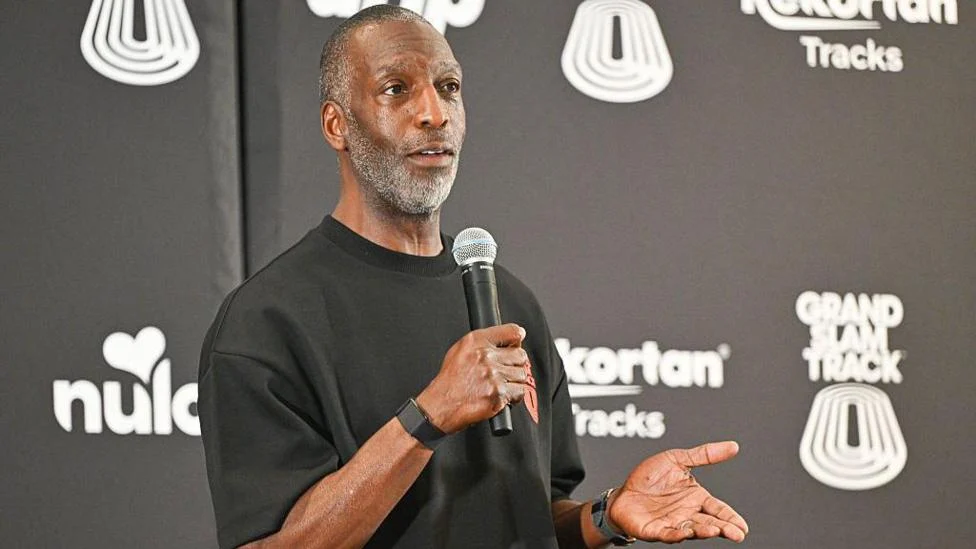
Four-time Olympic champion Michael Johnson has broken his silence following the bankruptcy of Grand Slam Track (GST), the athletics venture he founded in 2024. The competition, which promised lucrative salaries and prize money to its contracted runners, collapsed after its final event in Los Angeles was cancelled. Organisers subsequently filed for voluntary bankruptcy in the United States in December 2025.
In a recent interview with The Telegraph, Johnson confirmed that he has now “got the athletes paid” following what he described as a “catastrophic capital issue” triggered by investors withdrawing their support. The Association of Athletics Managers, representing numerous competitors, had previously reported in January that the organisation carried debts exceeding $30 million (£22.5 million).
The financial fallout left several high-profile athletes, including British former world 1500m champion Josh Kerr and 2024 Olympic 400m silver medallist Matthew Hudson-Smith, with outstanding payments reportedly exceeding £100,000. Johnson acknowledged the immense personal toll the situation took on him, noting that he spent many sleepless nights questioning his own integrity and character while managing the crisis.
Addressing specific allegations from a March 2026 legal filing by creditors, which accused him of “secretly” paying himself $500,000 (£375,000) just days before the company collapsed, Johnson described the claims as “hurtful” and the “exact opposite of what was reported.” He clarified that the payment was a reimbursement for travel expenses he personally covered when the company’s credit lines were exhausted.
“Our credit card was full at Grand Slam Track because we were facing significant cash-flow issues,” Johnson explained. “We had 96 athletes, plus companions, whom we needed to fly to Miami and Philadelphia. We had 170 people to house in hotels in both cities, and the credit card had no room left. I instructed our travel team to put it on my credit card, and I would be reimbursed for it. So, what I received was reimbursement.”
Beyond the reimbursement, Johnson stated that he took further steps to stabilize the company’s finances. “I also loaned the company $2m to make sure we took care of the athletes. I decided to forgo my own salary,” he added. Although he previously stated in March that he would repay the $500,000 to GST, he remains adamant that the original transaction was a legitimate business expense rather than a personal profit.
Reflecting on the public scrutiny, Johnson admitted that the accusations weighed heavily on his family and his professional reputation. “Those things weighed on me very heavily, and on my family as well. I was asking myself: ‘Are you stupid? Why did you do this? This is not what you need.’ That was the most difficult part of this. Questioning my motivation for doing this, questioning my integrity, questioning my character,” he said.
Johnson, who has served as a pundit and commentator since 2001, has not worked for the broadcaster since the Paris 2024 Olympics, having shifted his full focus to the development of Grand Slam Track. The resolution of athlete payments marks a significant step in closing the chapter on the failed venture, which had aimed to revolutionize the sport’s commercial landscape.
“I definitely had nights where I didn’t sleep, where I would be awake thinking: ‘This is on me.