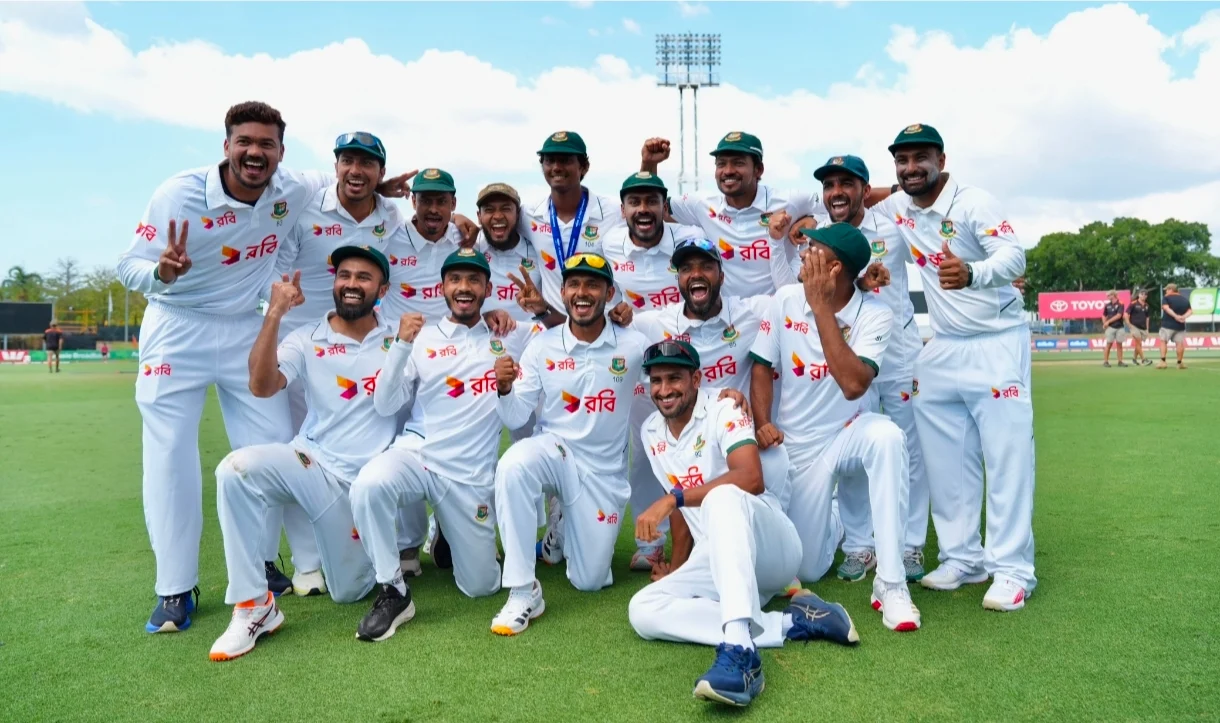
The sun over Darwin’s Marrara Oval burned with unusual intensity on August 16, casting a spotlight on a historic transformation in international cricket. While the stands featured only a scattering of red-and-green flags against the familiar Australian yellow-and-green, the atmosphere on the field was defined by a singular, unwavering resolve from the Bangladeshi side. That determination culminated in a historic nine-wicket victory, marking Bangladesh’s first-ever Test win on Australian soil and effectively closing a 23-year chapter of frustration.
The scale of the win was absolute, with Bangladesh dominating all 11 sessions of play. This was not merely a win; it was a comprehensive display of superiority in batting, bowling, tactical decision-making, and mental fortitude. The match statistics underscore the one-sided nature of the contest, as the visitors outplayed the hosts in every department, leaving Australia unable to regain momentum at any stage of the game.
Australia’s first innings collapsed for just 198 runs, with Steve Smith’s 71 being the only notable contribution. Hasan Mahmud spearheaded the Bangladeshi attack, claiming 6 wickets to dismantle the top-ranked side. Despite the absence of lead pacer Nahid Rana and the injury-enforced exclusion of Shoriful Islam, the bowling unit remained clinical. The combination of Mahmud’s pace, disciplined middle-overs bowling, and Mehidy Hasan Miraz’s spin ensured the hosts never found a rhythm.
Bangladesh’s batting lineup, often criticized for fragility in foreign conditions, responded with remarkable resilience. Tanzid Hasan Tamim silenced doubters with a maiden Test century, demonstrating a blend of patience and calculated aggression. Captain Najmul Hossain Shanto anchored the innings with 84 runs, while Mehidy Hasan Miraz contributed a skillful 65. Their efforts propelled Bangladesh to a total of 426, establishing a commanding 228-run lead. Although Josh Hazlewood took 6 wickets for Australia, the damage was already done.
In the second innings, Australia managed 284 runs, bolstered by a fighting 104 from Cameron Green. However, the deficit proved insurmountable. On the fourth morning, Mehidy Hasan Miraz dismantled the remaining resistance, dismissing Alex Carey, Beau Webster, and Pat Cummins. After the break, Taskin Ahmed removed Mitchell Starc, and Miraz secured his 15th career five-wicket haul—his third on foreign soil—by trapping Nathan Lyon lbw. Miraz’s all-round performance, including his half-century and five-wicket haul, cemented his role as a primary architect of the victory.
Hasan Mahmud, who finished with 9 wickets in the match, was named Player of the Match. His dismissal of Green, who had batted for nearly five hours, highlighted his precision. Despite the criticism surrounding his selection prior to the series, Green’s century was the only significant resistance Australia could muster. The disparity between the two teams was further widened by Shanto’s captaincy, as his strategic bowling changes and field placements proved to be masterstrokes throughout the match.
The magnitude of this achievement is amplified by the team’s recent preparation. Only days before the Test, Bangladesh had been bowled out for just 54 runs in a warm-up match against the Cricket Australia XI. Overcoming such a setback to defeat a top-ranked team by nine wickets is a testament to the squad’s character. Shanto described the win as the greatest in Bangladesh’s history across all formats, while Pat Cummins graciously admitted that his side was outplayed in every facet of the game.
Australian commentator Jim Maxwell labeled the defeat as one of the most embarrassing in the nation’s Test history. For Bangladesh, the victory serves as a profound statement to the global cricket community. It replaces the memory of two previous, brief, and painful Test appearances in Australia—which ended in innings defeats—with a new narrative of pride and capability.
As the team looks ahead to the second Test beginning August 22 in Mackay, the challenge lies in maintaining this momentum. The victory in Darwin is not just a statistical milestone; it is a psychological turning point. Bangladesh must now convert this historic success into sustained confidence as they prepare for new conditions and an inevitable Australian tactical response.
August 16 will be remembered as the day Bangladesh redefined its cricketing identity. By moving past the 23-year-old history of struggle, the team has proven that they can compete and conquer at the highest level. This victory, etched into the annals of cricket, stands as a testament to a new era for Bangladesh, proving that they are no longer just participants, but formidable contenders on the world stage.