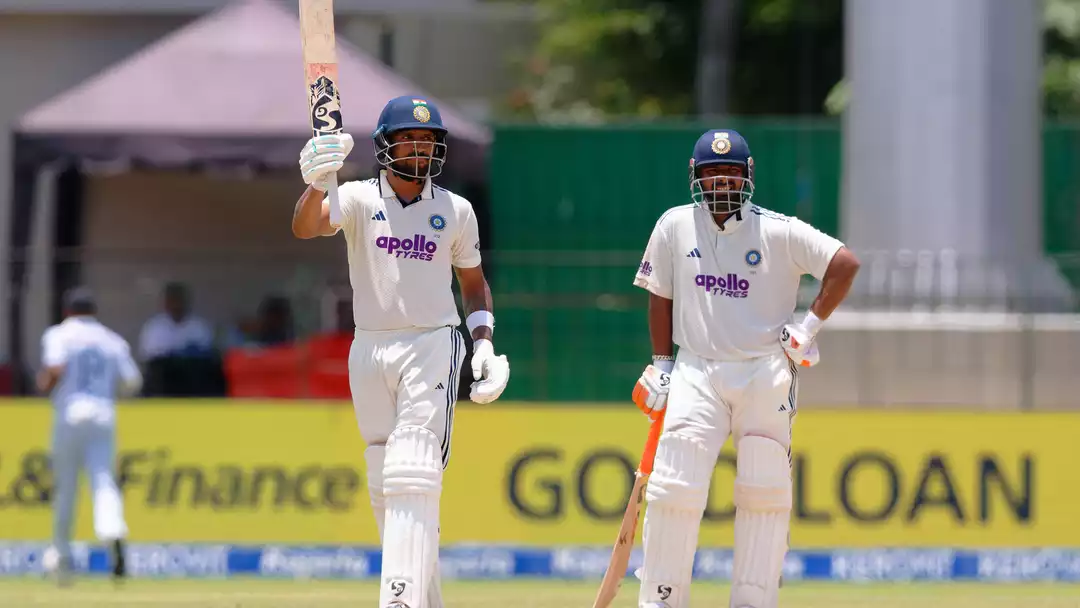
Sri Lanka entered the second day of the Colombo Test anticipating that Rishabh Pant would be sidelined after suffering a hand injury on Sunday. Bowling coach Ryan van Niekerk had prepared his pace attack to exploit the new ball, believing there was a 50-50 chance Pant would not return. However, just 11 balls into the morning, Pant resumed his innings alongside Dhruv Jurel, proving once again his remarkable resilience—a trait previously seen during his injury-defying appearance at Old Trafford last year.
While the Sri Lankan bowlers focused their tactical efforts on containing Pant’s aggressive, high-risk approach, Dhruv Jurel quietly dismantled their plans from the other end. The contrast between the two wicketkeeper-batters is stark: Pant’s innings are defined by anticipation and explosive scoring, whereas Jurel’s contributions are marked by a calm, methodical accumulation that often catches opponents off guard. In this Colombo encounter, Jurel emerged as one of only three Indian batters to face more than 100 deliveries, maintaining a superior control percentage of 91.6 compared to Pant’s 84.3.
Jurel’s rise to a specialist batting role has provided India with a crucial cushion in the middle order. His ability to anchor the innings is particularly valuable in challenging away conditions, as evidenced by his consistent performances in Australia in 2024 and England in 2025. His 34-run contribution during a pivotal second-innings victory at The Oval, while filling in for an injured Pant, solidified his standing. By the time the home series against South Africa arrived late last year, Jurel had become an indispensable part of the side, forcing a tactical shift that saw India move from choosing between the two keepers to fielding both simultaneously.
Former batting coach Vikram Rathour describes Jurel as a “perfectionist” who possesses a rare, technically sound approach in an era dominated by high-risk shot-making. Rathour, who first recognized Jurel’s temperament during his 90-run knock on a low-bouncing Ranchi pitch in early 2024, notes that the young batter is constantly seeking improvement. Even after impressive net sessions, Jurel often questions his own performance, seeking additional drills to refine his game. This relentless work ethic has left him with few visible weaknesses, a reality Sri Lanka has faced repeatedly over the last two weeks.
Jurel’s dominance against spin in Colombo was a highlight of his second Test century. Facing 101 deliveries of spin, he scored 56 runs with a control rate nearing 90 percent. He displayed exceptional technique against Keshara Nuwantha and Prabath Jayasuriya, even as the pitch conditions grew increasingly difficult, with nearly half of the deliveries on Day 2 turning by more than 4.5 degrees. His defensive compactness allowed him to neutralize the threat of the spinners entirely.
The opposition’s attempts to unsettle him with short-pitched bowling were equally ineffective. After sending down seven bouncers, Sri Lanka’s pacers abandoned the tactic as Jurel comfortably accumulated 15 runs without offering a single chance. Having proven his worth through consistent performances on shadow A tours and at the international level, Jurel has successfully transitioned from a backup option to a cornerstone of the Indian batting unit, providing the team with a level of stability that has proven to be a significant competitive advantage. The report also notes that sri Lanka perhaps went to bed on Day 1 of the Colombo Test assuming they had already seen the last of Rishabh Pant for the first innings. The report also notes that but 11 balls into the morning session, Pant strode out to join Dhruv Jurel. The report also notes that this is, after all, the same player who came down a flight of stairs to awe and applause from the Old Trafford crowd last year. The report also notes that bowling lines switched and the short balls kept coming, fields changed.