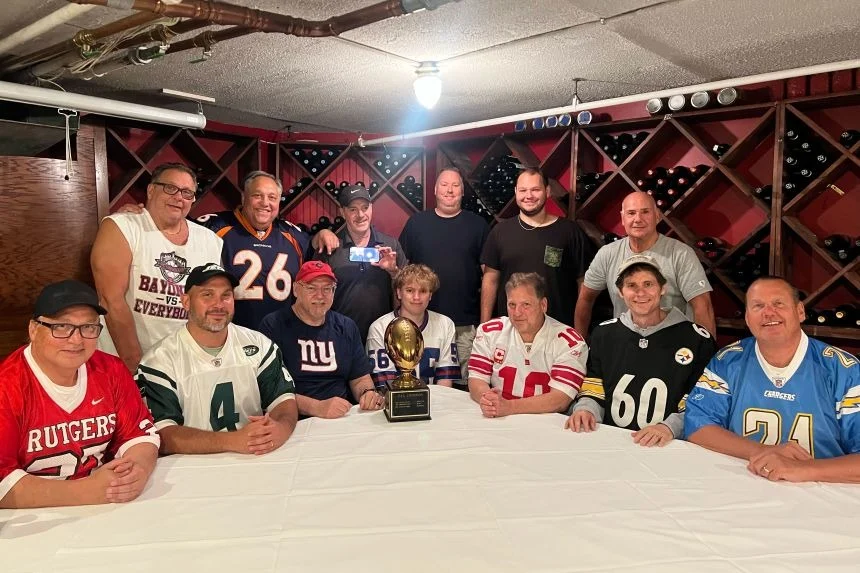
On the final Sunday of August, a group of men gathered at a steakhouse in New Brunswick, New Jersey. Despite many being old enough to have grandchildren, the atmosphere was charged with the familiar, youthful energy of a fantasy football draft. Before 10:30 a.m., members were already donning jerseys and trading accusations of cheating, setting the stage for a day of drinking, burgers, and intense competition that has become a cornerstone of their friendship.
The league traces its roots back to 1992, when eight friends from the Rutgers University Sigma Pi fraternity decided to organize their own competition. Dave Koval, the 61-year-old commissioner who has led the league since its inception, recalls a time before the internet and standardized digital platforms. In those early years, the group relied on the Monday edition of USA Today to manually track statistics and calculate scores by hand. According to Koval, the league has remained active every single year since that initial season.
As the league has matured, so has its membership. There are now 12 teams, with six of the original eight owners still participating. The group has seen members retire, relocate, and navigate the various stages of life, from weddings and births to the more somber reality of attending friends’ parents’ funerals. Koval, who recently lost his father at age 99, views the annual draft as a vital, happy occasion where the group can reconnect and recount stories from their college days in the mid-1980s.
Longtime member Scott Page, who serves as the league’s self-described curmudgeon, admits that while he prefers the old-school, analog nature of the game, he values the consistency the league provides. Page, who refuses to use a laptop during drafts, relies on handwritten notes, a habit that draws constant teasing from his peers. Despite his complaints about the shift toward digital interfaces, Page acknowledges the deeper significance of their gathering, noting that it represents a rare, reliable bond that keeps them connected despite the challenges of aging.
Mark Pascal, another original fraternity brother who joined the league in 1994, has hosted the draft at his New Brunswick steakhouse for most of its history. Although he stepped back from active ownership in 2004 to balance family commitments, he remains a central figure and advisor to the group. For Pascal, the passage of time seems to vanish the moment they reunite, as if they had only seen each other weeks prior. He emphasizes that the league provides a constant, reliable anchor amidst the ups and downs of their personal lives.
The league has intentionally kept its financial stakes modest, with entry fees rising only slightly from $100 to $130 over the decades. This focus on community over profit distinguishes their tradition from the booming, often solitary world of mobile sports betting. While the Fantasy Sports & Gaming Association estimates that over 50 million American adults participate in fantasy sports, for this group, the activity functions more like a social institution than a gambling venture.
The tradition is now entering a new phase as it welcomes the next generation. Nick Mosso, a 62-year-old original member who recently suffered a pulmonary embolism, has invited his 22-year-old son, Dominic, to join as a co-owner. Similarly, Chris Pascal’s son, 37-year-old Brian, has been a league member since graduating college in 2012. Brian Pascal notes that he feels as though he grew up within the culture of this specific fantasy league. For the elder Mosso, the goal is clear: he hopes the draft will foster the same camaraderie among his son and the younger members that has sustained his own friendships for over 30 years. The report also notes that break for burgers a little after noon and plan to be here all day, they’ll start drinking before 11 a.m. The report also notes that it’s a tradition that predates children and marriages. The report also notes that “It was before the internet, before websites and rules and standardizations. The report also notes that “I thought it was way better when it was guys getting together, watching the game, arguing. The report also notes that ‘Your guy sucks, he’s no good!’ You know, that kind of stuff,” says Scott Page, the league’s resident curmudgeon. The report also notes that “Over the last 30 years, it’s migrated into this computer-phone-tablet-internet kind of a league. The report also notes that wearing a Pittsburgh Steelers jersey with his own name on the back over the number 60 – a gift from when he reached that illustrious age this year – Page is lamenting the most typical tragedy: Getting older. The report also notes that the loss that is no longer being in your early 20s, unencumbered by anything that might interrupt plans to spend every autumn weekend focused on the fantasy football league formed among your fraternity brothers, it’s a feeling all too familiar.