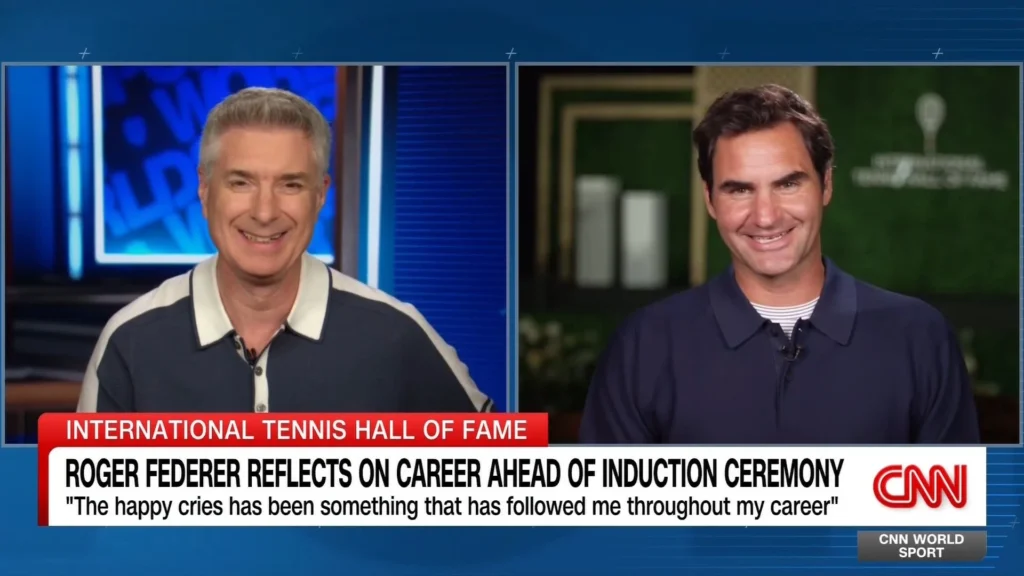
Roger Federer is bracing for a wave of emotion as he prepares to be inducted into the International Tennis Hall of Fame in Newport, Rhode Island. The Swiss icon, long known for his tearful reactions to major victories, admits that the presence of his family, coaching staff, and support team could make the ceremony particularly poignant. He noted that if the moment hits home hard, it will simply add to the personal significance of the occasion, though he hopes to deliver his speech without too many interruptions.
The tennis legend’s history with public displays of emotion dates back to his 2001 Wimbledon debut. After defeating his hero, Pete Sampras, on Centre Court, Federer recalled feeling overwhelmed. He told reporters that he dropped to his knees and shook hands with Sampras, only to be hit by a sudden rush of feelings. At the time, he was confused by the reaction, questioning why he was crying when that was not his normal demeanor. That moment marked the beginning of a career that would eventually see him become one of the most celebrated figures in the sport, lasting until his final professional farewell in 2022.
Federer’s path to the Hall of Fame was cemented by a period of unprecedented dominance starting in 2004. That year, he secured three of the four grand slam titles and began a record-breaking streak, holding the world number one ranking for 237 consecutive weeks. His 2006 season remains a benchmark for excellence, featuring 12 titles and a 92-5 match record, representing a 94.8% win rate. By 2009, he surpassed Sampras’ record of 14 grand slam titles at Wimbledon, ultimately retiring with 20 majors—a tally later eclipsed by Rafael Nadal and Novak Djokovic, though many fans still consider him the greatest of all time.
Reflecting on his playing style, Federer addressed the common misconception that his success came easily. While his grace on the court made his movements appear effortless, he emphasized that his performance was the result of immense sacrifice and internal pressure. He recalled that as a youth player, people often misread his fluid style as simplicity, ignoring the rigorous work behind his power. He noted that he was often criticized for not trying hard enough when he lost, yet labeled as having it too easy when he won, a contradiction that added to the weight he carried throughout his career.
Today, Federer has found peace away from the professional circuit. He is content with a slower pace of life, focusing on his roles as a father of four, a philanthropist, and a businessman. While he still enjoys traveling, he feels no void left by the absence of competitive pressure. He remains open to new challenges, such as improving his golf game and returning to the piano, an instrument he played in his youth and which his family members currently enjoy.
Looking back at the legends of the game, Federer shared that he would have loved to compete against icons like Rod Laver, Bjorn Borg, John McEnroe, Stefan Edberg, and Boris Becker, alongside his classic rivalries with Sampras. He expressed deep admiration for their personalities and contributions to tennis. As he prepares for his induction, he remains focused on his personal priorities: being a good listener, a reliable decision-maker, and a devoted family man who cherishes time spent with friends. The report also notes that the first time he cried after a big win, Roger Federer says he didn’t understand what was happening. The report also notes that from that moment until his tearful farewell in 2022, Federer carved out one of the most remarkable careers in tennis history and became arguably the most famous crier in sports. The report also notes that “If I’m speaking about the game and all the gratitude that I have, and having my entire family there – from my parents to my wife to my four children and my whole team from coaching staff and physios, etc. The report also notes that “If it happens, it will be more memorable for me personally, but I hope I get through the speech without too many hiccups. The report also notes that when he captured three of the four grand slam singles titles and ascended to the top of the world rankings, remaining at the summit for an extraordinary 237 consecutive weeks – still a record, it’s been an obvious destination since 2004. The report also notes that in 2005, he won over 95% of his matches, but 2006 is considered to have been his peak season: Another trio of major championships and a total of 12 titles won with a record of 92-5 – a 94.8%-win rate. The report also notes that but Federer blew past him at Wimbledon in 2009 and never looked back, few thought Sampras’ record of 14 grand slam titles would ever be broken.