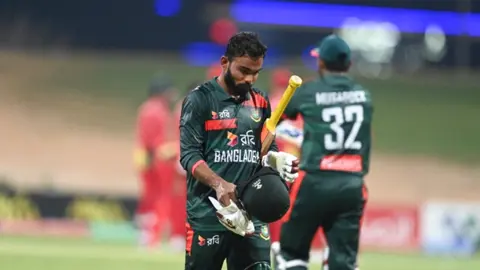
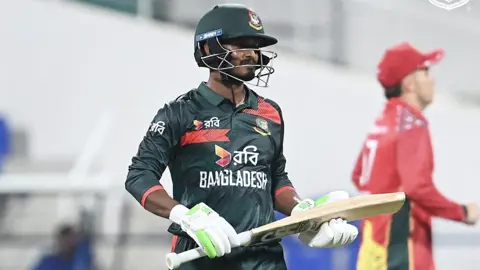
Bangladesh’s campaign in the tri-series opened on a grim note following a heavy 99-run defeat to Zimbabwe in Abu Dhabi. Chasing a target of 272 runs, Bangladesh collapsed to 172 all out in just 33.4 overs. The top order showed brief promise, reaching 66 for 2 after 10 overs, but a flurry of quick wickets shattered the chase. Tanzid Hasan offered the only notable resistance with a 38-ball 46. The loss once again highlighted a recurring pattern, as Bangladesh has now been defeated in three of their four ODI meetings against Zimbabwe this year.
The defeat has sparked widespread debate over Bangladesh’s selection strategy, particularly the choice to field only four specialist bowlers on a batting-friendly pitch. Strategic options like Hasan Mahmud, Tanveer Islam, and debutant mystery spinner Alis Al Islam were left on the sidelines. Instead, the team fielded three pacers—Taskin Ahmed, Mustafizur Rahman, and Shoriful Islam—alongside leg-spinner Rishad Hossain. The remaining 10-over load was assigned to part-time bowlers Mosaddek Hossain, Soumya Sarkar, and Saif Hassan, who collectively took 3 wickets for 68 runs over 11 overs. Though their stats appeared acceptable, relying on part-timers was criticized as reflecting a defensive mindset.
Team balance was disrupted prior to the toss when regular captain Litton Das was ruled out of the entire tri-series after failing a fitness test due to right hip joint pain. Senior all-rounder Mehidy Hasan Miraz was also sidelined with a fever. In response, the management selected Saif Hassan to deepen the batting line-up, though questions linger over his credentials as a genuine all-rounder. Soumya Sarkar, who replaced Litton in the playing eleven, failed to make an impact with the bat. Looking ahead, Parvez Hossain has been called up to reinforce the batting, which could result in Nurul Hasan dropping out for the next match.
Bangladesh’s batting struggles extend far beyond a single game. Since the Pakistan series in March, Bangladesh has played 10 ODIs, winning 5 and losing 5. Alarmingly, the team has been bowled out for under 235 runs in four of those matches. Notable low totals include chasing 248 against New Zealand and being restricted to 221, failing to chase 142 in Harare when they were bowled out for 116, falling short at 234 while chasing 248, and the recent collapse to 172 against Zimbabwe.
When chasing targets over 240 runs, Bangladesh’s record is particularly troubling, suffering losses in eight of their last 10 such matches, with their only victories coming twice against Sri Lanka. The batting lineup has posted scores over 270 only twice in this span, both against Australia when they scored 284/8 and 274/5. During the Pakistan series, one rain-affected match saw them bowled out for 114 while chasing a DLS target of 243, though a subsequent total of 290/5 demonstrated their capability to put up sizable totals when in form.
As Bangladesh utilizes this tri-series to prepare for the upcoming World Cup, the opening defeat places severe pressure on their campaign. Another stumble in the next fixture could endanger their position in the tournament. Resolving deep-seated batting vulnerabilities and refining team composition have now become urgent priorities for the management.