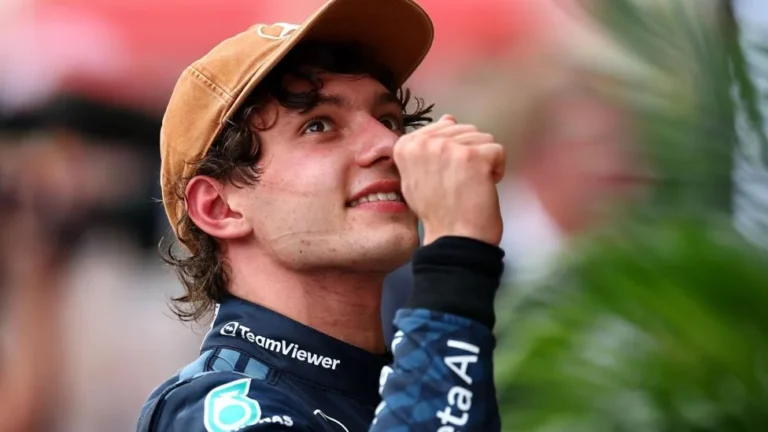

Kimi Antonelli is now just two points away from making Formula One history as the sport’s youngest world champion and its first Italian titleholder in 73 years. The 20-year-old delivered a dominant performance at Sunday’s United States Grand Prix to secure his ninth victory of an extraordinary debut season, leaving Mercedes team principal Toto Wolff to declare it as “his best so far” while confirming the ‘Silver Arrows’ remain the benchmark on the grid. With five races remaining, AFP Sport looks at three things we learned from the 20-year-old Italian’s ninth win of an outstanding season.
Despite having five rounds left on the calendar, Antonelli’s transition into a complete, strategically minded driver has set him apart. Wolff noted that after remarkable wins in Monaco and Monza, Sunday’s drive was “the race of a champion who isn’t the champion yet.” The team chief recounted a relaxed pre-race meeting in his office, where Antonelli put his feet up on Wolff’s chair and casually mentioned that he was not even thinking about the title fight. Wolff described this calm demeanor before such a defining career moment as an innate quality that cannot be coached.
The stark difference between Antonelli and his teammate George Russell highlighted the Italian’s rapid rise. Antonelli maturing fast and adding strategic authority to his arsenal A brief comparison with the misfortunes and struggles of his teammate and nearest rival George Russell reveals how rapidly Antonelli has developed from a daring precociously talented kid into a maturing competitor.
While Russell entered the year as the championship favorite following an opening win in Australia, he struggled with a severe five-second penalty and managed only an eighth-place finish in Austin—the absolute minimum required to keep his mathematical title hopes alive. Antonelli, meanwhile, flawlessly executed a one-stop strategy from pole position. Wolff acknowledged that recent upgrades were difficult to manage, observing that Antonelli’s driving style “just glues with the car” whereas Russell visibly struggled.
For Antonelli, the Austin triumph surpassed his legendary charge from 19th on the grid in Monza because of how he and his crew systematically built performance across the entire weekend. He executed a bold strategic plan once he claimed pole position, demonstrating a newfound maturity that complements his raw velocity. Overall, a good weekend for pace and execution.
In contrast, Red Bull endured a chaotic race plagued by strategy failures, poor radio communication, and inner-team friction. Four-time world champion Max Verstappen finished third behind Ferrari’s Charles Leclerc, expressing deep frustration after an aggressive opening strategy featuring two stints on soft tyres backfired. Verstappen described the team’s pace as “a little bit average” and slammed the persistent radio blackouts as a complete disaster, sarcastically suggesting they might as well use sign language instead.
Red Bull newcomer Isack Hadjar also endured a tough outing, starting third and dropping to sixth. The French rookie struggled to manage hard tyres while losing time due to incorrect engine mapping caused by poor pit radio signals. Hadjar called for an immediate technical review and a new clutch design, while also displaying reluctance to yield easily when team orders instructed him to let Verstappen pass.
Ferrari experienced their own brand of disappointment despite topping all three practice sessions leading into qualifying. A slight misstep on the final lap of Q3 ruined their starting position, ultimately leaving them with second and fourth-place finishes in the main race when higher results seemed well within reach. Except for the final lap in Q3 when with the tyres, the window to improve is very narrow… and you can go from a super result to nowhere for a gust of wind or a slide too much, all went well.
Ferrari team boss Fred Vasseur admitted that Charles Leclerc was firmly targeting the win and was naturally dissatisfied with second place, though Vasseur welcomed that competitive hunger. He noted that without a late Virtual Safety Car, Lewis Hamilton might have mounted a challenge on Verstappen for the final podium spot. Vasseur emphasized that while a minor gust of wind or slide during qualifying can wipe out a weekend’s potential, channeling that resulting frustration will be key moving forward.