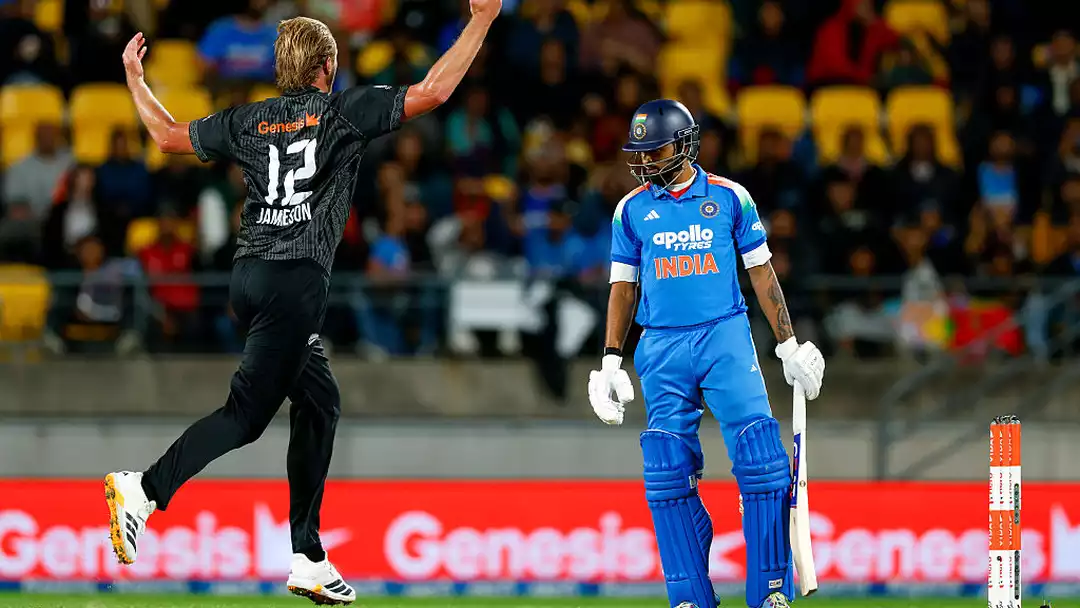
Shreyas Iyer provided a glimpse of pure fluency early in his innings at Wellington, carving a delivery from Jacob Duffy over cover for six. There’s a distinct fluidity and verve to Shreyas Iyer’s batting that can sometimes circumvent a difficult pitch. Six balls into his innings, Iyer did one of those things: all wrists, barely a shift of the feet, a fierce swing of the bat to carve the ball over cover for six, in Wellington. Most of Iyer’s fluency was buried in the texture of a pitch that offered all of pace, seam and lift to bowlers, for the next 38 balls after that shot. For him, a short ball appears to almost stall and travel in slow-motion, until the bat meets it and resets its velocity. Ironically, the same shot brought his downfall too.
However, that moment of brilliance proved fleeting as the pitch offered significant pace, seam, and lift, forcing batters into a prolonged struggle.
Iyer eventually fell to an ungainly dismissal, once again troubled by the short ball, an issue that has frequently hindered his performance in the past. The perceived difficulties from which, have “triggered” him in the past, the dismissal will reignite a topic he admittedly hates: the short ball. Axar’s first ball sharply lifted past him and nearly took along a glove to a diving Glenn Phillips. Dhir might have had the image of Iyer’s dismissal from a few overs ago.
Shubman Gill described the surface as both tricky and challenging, a sentiment echoed by Mitchell Santner, who admitted there was no hiding from the difficulty of the conditions. The challenging nature of the pitch made India’s modest chase of 135 a tense affair. Despite an early strike from India, the top order faced consistent pressure, with Virat Kohli and Gill dismissed by the movement and seam on offer. The double strikes still looked like recoverable setbacks, for the target was just 135, that Iyer stroke took India to 27/2: at that point.
Rohit Sharma attempted to counter the rising deliveries with aggression, notably hitting a six off Kyle Jamieson. For Rohit, the short ball appeared manageable, yet he eventually succumbed to the pitch’s movement while trying to force the pace. By the time India reached 39/3, the game remained in the balance, and New Zealand tightened their grip by deploying a concentrated short-ball strategy. With little room to play, Jamieson’s idea would have emerged from India’s own ploy earlier in the game. Ignited by the tall frame of Gurnoor Brar, much of New Zealand’s middle-order had been engulfed by pace and skiddy bounce. And Rohit wasn’t the batter to bother it with. Next ball, he sized up the relatively lower bounce early, and put force underneath it, crunching it for six behind square.
Axar Patel briefly offered resistance, using a cheeky ramp shot against Nathan Smith to find boundaries, but he eventually fell attempting the same stroke against Matthew Fisher. Naman Dhir also struggled with the short-ball tactic, caught at the boundary after being surprised by a Jamieson delivery. This sequence of dismissals underscored the host’s tactical success in restricting India’s middle order. He turned into an awkwardly tangled figure, surprised by a Jamieson bumper.
New Zealand’s own batters were similarly hindered, with five players losing their wickets to the short ball.
Statistical analysis showed that only two players across both sides—Tom Latham and KL Rahul—maintained a false-shot percentage in single digits against short-length deliveries. Latham proved particularly composed, while Rahul demonstrated superior boundary-hitting capability, scoring 24 runs off 14 short-pitched balls. Whose percentage stood at 6.6, the other was KL Rahul.
Rahul’s ability to handle the threat was highlighted in a decisive sequence against Nathan Smith, where he rolled his wrists to guide a helmet-high ball for four, followed by a six. Rohit Sharma and Rahul proved the most effective at counter-attacking, collectively scoring 39 runs off 22 balls against that specific length, a surge that ultimately nudged India past the DLS par score before rain halted play. Counter-attacking the threat better than anyone else, rohit (37.50) and Rahul (28.57) had the highest boundary percentages against short lengths. Together, they fetched 39 off 22 balls against the most fruitful bowling length of the game. Either way, the strategy tested India’s approach against that length, which nearly opened the game before another bout of showers crushed the hosts’ hopes.
Kyle Jamieson praised Rahul’s composure after the match, noting his experience observing him during their shared time with the Delhi Capitals. While India occasionally over-compensated, the early boundaries from Rohit and the clinical finish from Rahul provided enough momentum to navigate the team through the pressure. Then, Iyer had borrowed just enough from elementary gymnastics to arch out of danger, falling flat on his back. According to “He’s obviously class, right?”, Jamieson, After the game, drawing the inference after having bowled at him in every practice at Delhi (Capitals) for two months. “Like, he’s so good and such a rock-solid player at tha. But the early runs from Rohit, and the calculated attack from Rahul at the end ensured even their scratchy pursuit had enough fuel to take them over the line, india over-compensated at times.
Reflecting on the match, Gill admitted that the team’s late-innings shot selection left much to be desired. He noted that if the game had been decided by the DLS method, resulting in a loss of four or five runs, the outcome would have certainly been regarded as a stinker for the touring side.