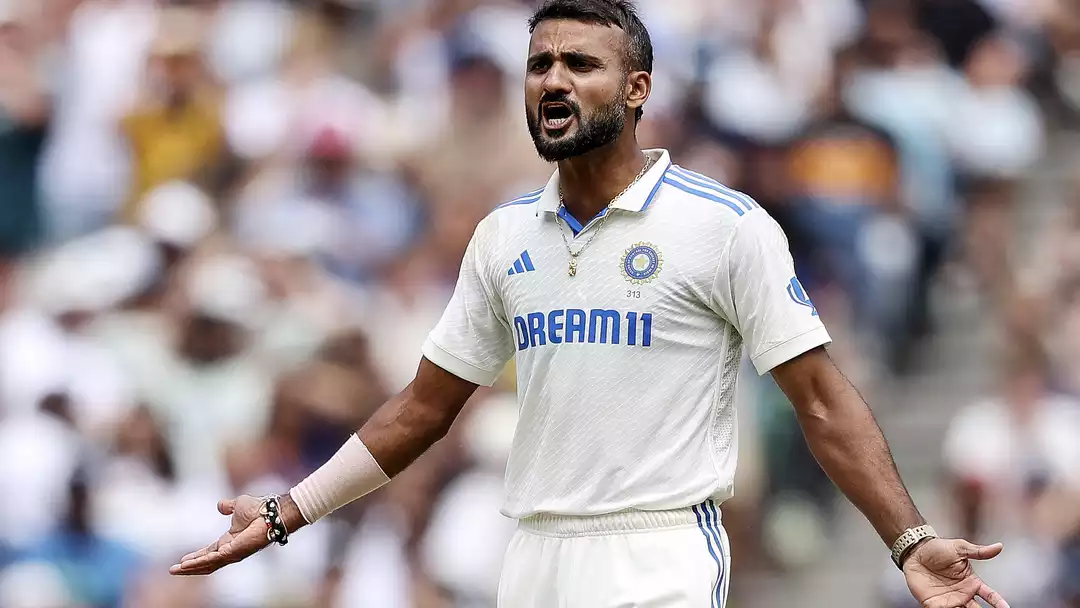
Approaching his 30th birthday, Akash Deep is embarking on a pivotal second act in his professional cricket career. A significant stress fracture in his back, sustained nine months ago in Kalyani, forced a premature end to a promising ten-Test journey. During his absence, the competitive landscape of Indian cricket shifted significantly, with the national team handing international debuts to six different frontline pace bowlers since his last appearance in 2025. Every missed chance can be a step backwards, for a late bloomer in the Indian setup. He turns 30, in a few weeks.
Despite the high turnover, Akash has fought his way back to contention, earning a selection for the New Zealand Test series, which marks his third overseas tour. Bengal head coach Laxmi Ratan Shukla described the recovery period as a grueling struggle of day and night. Throughout this period, Shukla maintained regular contact, counseling the fast bowler to focus on his physical rehabilitation while leaving the outcome to larger forces, advising that fixating on potential career setbacks would be counterproductive. A fit-again Akash reclaimed his spot in the squad, marking his third overseas visit, but for the New Zealand Tests. “He would talk to me once or twice a week. There’s nothing in our hands aside from getting fit, i would repeat the same thing: ‘Brother. “I still remember the ball that he got Rajat Patidar out in Indore in the Ranji (2022/23) semi-final, and he got Patidar out the same way in Mumbai (Thane) in one of the Vijay Hazare one-dayers (2023). But wicketless from 23 overs in the second, he took 2 for 57 and 1 for 25 in the first game. What to and not to eat, and even sleeping patterns, the recovery period gave an eager Akash time to better understand training processes.
The recovery process took place primarily at the BCCI Centre of Excellence, where Akash reconnected with coach Saurashish Lahiri. Their history dates back several years to when Lahiri, then working with Bengal’s youth setup, handpicked Akash for U23 trials. Lahiri noted that Akash’s transition from a raw talent with a tennis-ball background to a professional red-ball bowler has been a process of intense dedication—what he refers to as ‘tapasya’ or a cyclic penance involving strict discipline in diet, fitness, and work ethic. Itna zordaar hai (He’s remarkable).”. He was assessed via pre-defined tests, and a return-to-play was set at the start of the domestic season, as he checked into the Centre of Excellence.
Lahiri highlights Akash’s exceptional arm speed as his greatest asset, a technical trait derived from his tennis-ball origins. He does not have a luxurious lifestyle.
This background contributed to a natural, whippy delivery action and a flexible wrist, allowing him to flick the ball with impressive speed. He relied heavily on his whippy action and malleable wrist, habituated to hurling a much lighter tennis ball, barely aware of the biomechanics of full-tilt red-ball bowling. “The speed of his run-up, the release and flick of his wrists are absolutely perfect.
Over the course of his recovery, Akash channeled this same tenacity into his rehabilitation, resisting the temptation to rush his return to the pitch.
Lahiri’s guidance was clear: pushing too hard could lead to a secondary injury that would only extend his absence from the game. “I have seen many players in the CoE be very calm and composed (about their injury).
Shukla lauded the pacer’s character, noting that even after achieving international success, he remained grounded, often residing in the Cricket Association of Bengal dormitory. His jovial temperament and mental resilience were crucial to his recovery; instead of succumbing to self-doubt, he remained focused on optimizing his bowling mechanics. This mental fortitude, according to Shukla, parallels that of Mohammed Shami, with whom Akash shares a similar drive and strength.
Upon being cleared to bowl, Akash arrived with a meticulously prepared plan, discussing specific adjustments to his action with his coaches.
By October, he made a successful return during the Irani Cup, taking three wickets in each innings. Following this, he returned to the ground at Kalyani—the very site where his career had stalled—to sharpen his rhythm. Beyond his individual comeback, his return has provided a morale boost to the younger pace bowlers in the circuit, serving as a tangible example of how to navigate serious injuries. “Because to get those wickets, the length he has bowled… he is at his best”.
His progression has been rapid, moving from the domestic grind in Srinagar to the international stage in Lincoln, where he partnered with Anshul Kamboj to open the bowling. During these recent outings, Lahiri observed that Akash needed to fine-tune his lengths, as bowlers are most effective when they draw batters forward rather than allowing them to settle on the backfoot. The pair maintained a steady dialogue, with Lahiri reviewing Akash’s performances to help him identify when his length was slightly off-target. He had already excitedly chalked out plans in his head. ‘Sir, I am going to try this, do this in my action’, lahiri recalls when Akash was first cleared to resume bowling. Saying ‘I am going to go for this’, he used to make videos and send me (plans). “I have seen him get Tilak Varma out in Bhubaneshwar (Kolkata, in SMAT 2021), just poking at him from around the wicket, the ball angling in and then going straight. A long-time coach now with the CAB, watched Akash live for the very first time, and was impressed with how “rapid” he was: “He looked much sharper watching live than on television,” he said. “H, surendra Bhave. Before the game in Srinagar, Lahiri called him and reminded him of his best hits to refresh his muscle memory. “I always believe (he is bowling best) when he gets a right-hander out between his bat and pad, or he takes the nick off a right-hander, just behind the wicketkeeper or first slip.
Throughout this journey, Akash has shown himself to be a dedicated listener who remains open to tactical critique, regardless of his status as an international cricketer. His close association with Mohammed Siraj, developed during their time at RCB, has further helped him refine his approach. As he moves forward, the consensus is that he possesses both the skill and the mental discipline required to excel, with mentors hopeful that his trajectory will mirror the sustained success of other notable Indian fast bowlers.