
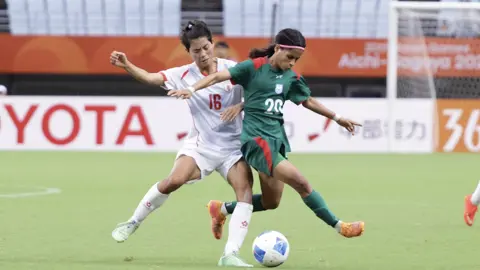
The Bangladesh women’s football team has wrapped up their campaign at the Ichi-Nagoya Asian Games, finishing with a scoreless draw against Myanmar. This final result cements a disappointing run for the squad, who failed to secure a win, score a single goal, or earn a medal throughout their three group stage matches. The Nagai Stadium scoreboard remained locked at 0-0 at the final whistle, mirroring the empty tally that defined their performance in the tournament.
Entering the match against Myanmar, the team hoped for a victory to end the campaign on a positive note. Despite Myanmar holding a significant advantage—being 52 places higher in the FIFA rankings—the squad felt optimistic. Coach Peter Butler and captain Maria Manda had expressed confidence, targeting the match as a realistic opportunity to secure a win after heavy defeats against North Korea and South Korea. However, the anticipated momentum failed to materialize on the pitch.
Statistical analysis highlights the team’s struggle to translate possession into scoring opportunities. Bangladesh managed to control the ball for 48 percent of the match and held some stability in the midfield. Yet, they were unable to penetrate the final third effectively, managing only three shots throughout the entire game, none of which were on target. This lack of offensive threat meant they never truly tested the Myanmar goalkeeper.
Conversely, the defensive unit faced significant pressure, with Myanmar launching eight shots toward the goal, two of which were on target. Goalkeeper Rupna Chakma proved vital, acting as a defensive wall during critical moments to deny the opposition and preserve the draw. While her efforts saved the team from a third consecutive loss, the collective output remained stagnant.
The broader performance metrics reflect a challenging trajectory for the team. In their previous two matches against the two Koreas, Bangladesh conceded a total of 16 goals. Compounding this, they were unable to score even once across all three group matches. When comparing these results to their previous Asian Games outing, the lack of progress becomes stark. In the 2023 edition, the team also finished with two losses and one draw, conceding 15 goals; this year, the total goal deficit increased slightly, and they again returned home without a win or a breakthrough goal.
This campaign has underscored clear areas requiring urgent development. The team struggled to organize effectively against stronger opponents, failed to build consistent paths from midfield to the attack, and lacked the clinical finishing required to convert rare opportunities. The repeated inability to score or secure results against higher-ranked teams confirms a stagnant growth cycle for the program over the past four years.
Ultimately, the scoreboard reading 0-0 against Myanmar served as a fitting conclusion to a tournament defined by null statistics. With no victories, no goals recorded, and no podium finish, the Asian Games experience for Bangladesh has been marked by a profound sense of underachievement, highlighting a critical need for structural improvement in their competitive approach.