
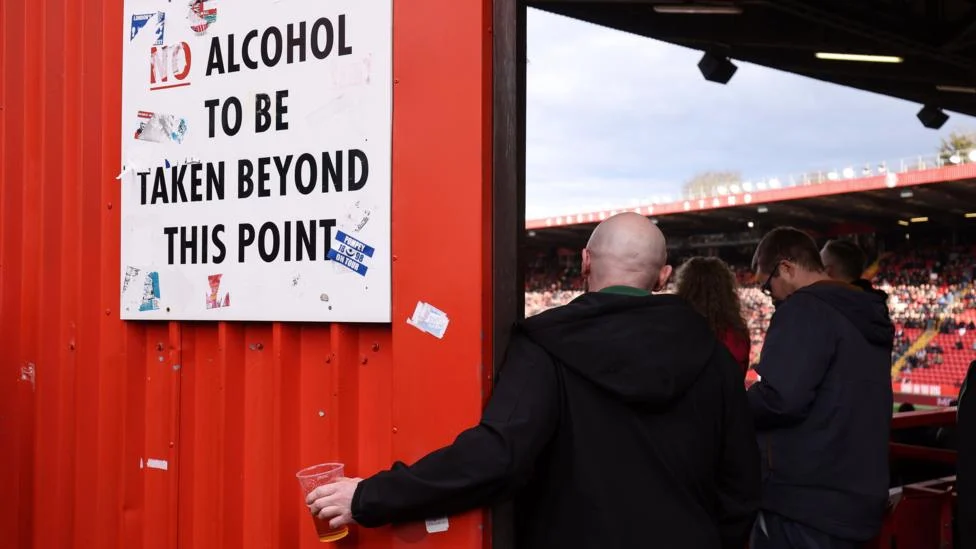
Prime Minister Andy Burnham has criticized the long-standing ban on consuming alcohol in the stands during men’s professional football matches in England, describing the policy as a form of discrimination. Under current regulations, which have been in place since 1985, supporters are prohibited from drinking alcohol within view of the pitch at stadiums across the top five tiers of the English game.
Speaking to journalists during a visit to the United Nations in New York, the prime minister reiterated his long-held opposition to the restriction. While he noted that his comments were not a formal policy announcement, he suggested that the rules deserve re-examination and could potentially be tested through a trial scheme. Burnham argued that it is unfair for football spectators to be uniquely restricted when fans of other sports, such as rugby league, are permitted to enjoy a drink while seated in the stands.
The legislative framework was established by Margaret Thatcher’s administration following concerns raised by then-Home Secretary Leon Brittan, who identified alcohol as a primary driver of violent and disorderly conduct at football matches. Addressing these historical concerns, the prime minister acknowledged the differences in the modern game while maintaining that current treatment of supporters is inequitable.
The Football Supporters’ Association (FSA) has welcomed these remarks, with chairman Tom Greatrex labeling the current laws outdated. Greatrex argued that criminalizing fans for having a drink at a match—even as they could consume alcohol in the same stadium for a music concert or a different sport—is unjust. He noted that numerous clubs support a review of the legislation.
However, the prospect of changing the law has met with resistance from police authorities. A spokesperson for the UK Football Policing Unit (UKFPU) warned that relaxing these regulations would pose significant safety challenges. The unit highlighted that football continues to experience levels of violence and criminality linked to alcohol that are not seen in other sports. They cautioned that any fundamental shift in policy without extensive expert consultation would be highly irresponsible.
Government sources have indicated that no immediate changes are planned. Any move toward reform would necessitate a comprehensive evidence-based investigation involving football clubs, fan organizations, and the Department for Digital, Culture, Media and Sport.
The issue has gained fresh attention following a 2021 fan-led review of football governance, which recommended that the law be reconsidered. Meanwhile, rules have already been partially relaxed in other areas; Women’s Super League (WSL) clubs have been permitted to sell alcohol in stands following successful pilot programs. In Scotland, where a separate ban has existed since 1981, recent trials have allowed fans to purchase alcohol at Hampden Park matches. The report also notes that a Wrexham fan holds his pint of beer while watching his team play Charlton Athletic. The report also notes that as he suggested a change could be trialled, the prime minister told reporters that “I don’t think it’s fair for football fans to be singled out”. The report also notes that burnham is a keen football fan and a season-ticket holder at Premier League team Everton. The report also notes that and I do believe there is a case to remove that discrimination. The report also notes that but I’m not going to back away from what’s been a long held view of mine. The report also notes that i don’t see how it can be fair that some supporters of one sport can be treated differently.
