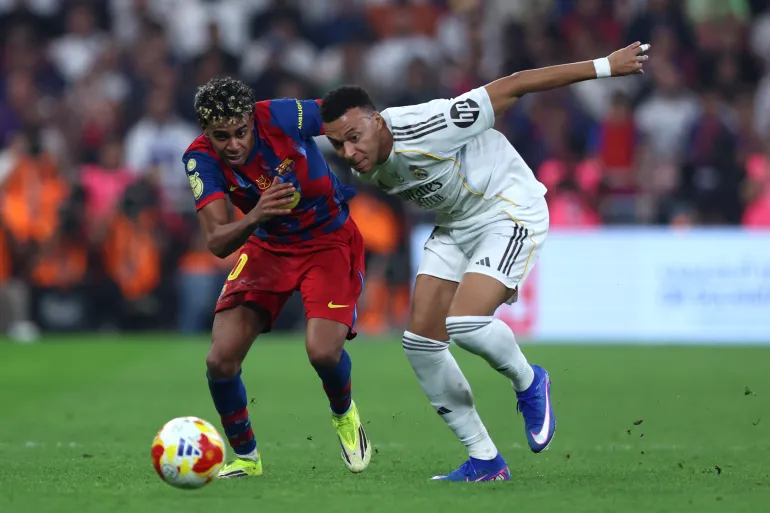
This Sunday, the highly anticipated El Clasico clash between Barcelona and Real Madrid will be captured by up to 40 specialized cameras. The broadcasting production is set to include dedicated tracking for star players Lamine Yamal and Kylian Mbappe, occurring just one day prior to the announcement of the annual Ballon d’Or winners.
La Liga categorizes matches featuring these two giants as “Category A” events, which mandate a minimum of 22 cameras.
High-profile encounters like the El Clasico or the Madrid Derby are elevated to “A+” status, requiring between 35 and 40 cameras positioned according to a strict, pre-defined shooting map that dictates specific angles and coverage zones. This information is shared directly with the referees’ committee and the VAR team to assist in reviewing controversial officiating decisions. Advising them of the available image sources for reviewing refereeing decisions, the details are made available to the referees’ technical committee and the Video Assistant Referee (VAR) technology team.
This expanded production setup arrives following criticism regarding a recent match between Real Madrid and Sevilla. During that game, an off-the-ball incident involving Real Madrid’s Arda Guler and Sevilla’s Peque Fernandez occurred in the 24th minute. Despite having 26 cameras present, none provided a definitive angle to clarify the contact, fueling an ongoing debate about whether existing television infrastructure is sufficient for high-stakes officiating. None of the available angles provided a clear enough picture to determine the nature of the contact between the players, thereby reviving the debate on whether television coverage can provide the angles required to decide in controversial cases, despite 26 cameras being used during the match.
Technicians note that camera count alone does not guarantee perfect clarity, as results depend heavily on lens orientation, proximity to the action, and physical placement. The upcoming broadcast will utilize cinematic and long-range lenses, shifting from full HD to 4K resolution. This allows production teams to provide sharper replays of penalty area incidents, dangerous goal opportunities, and tight collisions.
The broadcast strategy also integrates cameras positioned behind both goals, alongside high-speed equipment capable of detailed slow-motion playback. The league has a long history of investing in such technical advancements. In 2017, for instance, a similar 40-camera operation was used, incorporating aerial helicopter shots and cranes, while also tracking legends Lionel Messi and Cristiano Ronaldo, with over 400 production specialists on-site. According to the cameras will be placed across Camp Nou Stadium as part of a television production plan that includes ultra-high-definition filming, slow-motion replays, and individual player tracking techniques, Spanish newspaper Mundo Deportivo, On Tuesday. Directing and television production were involved, more than 400 specialists in photography.
Innovation remains a priority for the league, which previously trialed 360-degree replays in 2016. This system allowed for three-dimensional perspectives of gameplay. That technology has since evolved into a sophisticated stereoscopic system using 38 high-resolution cameras, enabling viewers to experience virtual angles from positions virtually identical to the players on the pitch. In 2016, El Clasico experimented with 360-degree replays using a system based on cameras distributed around the stadium to produce three-dimensional images, allowing the director to show some scenes from virtual angles t.
In recent years, broadcasting standards have regularly scaled between 32 and 38 cameras, depending on the specific venue and match requirements. These production suites now incorporate a mix of drone footage, live data integration, visual effects, and advanced cinematography to provide fans with the most comprehensive viewing experience possible.