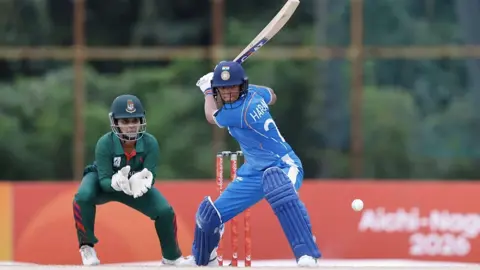
The scenic beauty of the Nagoya Kharogi Athletic Park, with its towering rows of trees and open grassy fields, provided a stunning backdrop that stood in sharp contrast to the grim reality Bangladesh faced on the pitch. Within this picturesque green setting, the Bangladesh women’s team appeared remarkably helpless. While India showcased powerful, aggressive cricket, Bangladesh played with visible trepidation, succumbing to the weight of the high-stakes semifinal.
Match Statistics
- India: 195/4, 20 overs (Mandhana 37, Shafali 100*, Harmanpreet 40; Marufa 1/43, Meghla 1/25, Rabeya 1/35, Nahida 1/48)
- Bangladesh: 81/10, 15.4 overs (Dilara 27, Sharmin 10, Sultana 12*; Nandini 3/25, Sri Charani 2/7, Shreyanka 1/22, Deepti 3/7)
- Result: India won by 114 runs
India’s dominance began early as Smriti Mandhana and Shafali Verma hammered 72 runs during the six-over power play. Although Nahida Akter eventually dismissed Mandhana for 37, the relief was temporary. Shafali Verma continued her onslaught, dismantling the Bangladeshi bowling attack and stitching together a 94-run partnership with captain Harmanpreet Kaur. The Bangladeshi bowlers struggled to maintain line and length, while the fielders failed to apply necessary pressure.
The individual performance of the day belonged to Shafali Verma, who reached a magnificent century in just 49 balls, capped off with a six in the final over. It was her maiden T20 century, marking a brutal end to Bangladesh’s defensive plans. Harmanpreet Kaur contributed 40 runs before falling to Rabeya Khan, but by then, the momentum had firmly tilted toward the opposition.
Facing an daunting target of 196, the Bangladeshi batting lineup completely collapsed. The team lost their first three wickets for just 38 runs during the power play, effectively signaling the end of any realistic chase. The top-order batters struggled significantly, with four of the first five players falling for single-digit scores. Captain Nigar Sultana Jyoti failed to find her rhythm, and the team’s inability to rotate strike or find boundaries left them completely isolated against the Indian bowling unit.
Dilara Akter offered a brief resistance with 27 runs, but upon her departure, the team score stood at 49 for five. The remaining five wickets added a mere 26 runs, with Sultana Khatun remaining unbeaten on 12. This result was not merely an individual failure but a collective collapse that left the team unable to mount a serious challenge against a side that appeared well-prepared and aggressive.
This performance raises significant questions about the team’s psychological approach to high-pressure games, especially against India, following a similar defeat in the Asia Cup semifinal. The failure to adapt to the intensity of a knockout match highlights a persistent gap in the team’s developmental progress. While the dream of gold has faded, the path to a podium finish remains open.
Bangladesh will now face Pakistan on September 22 in a battle for the bronze medal. Supporters will look for a much-needed resurgence, hoping that the team can shed the fear that plagued them in this semifinal and display the fighting spirit required to secure a medal for the nation.