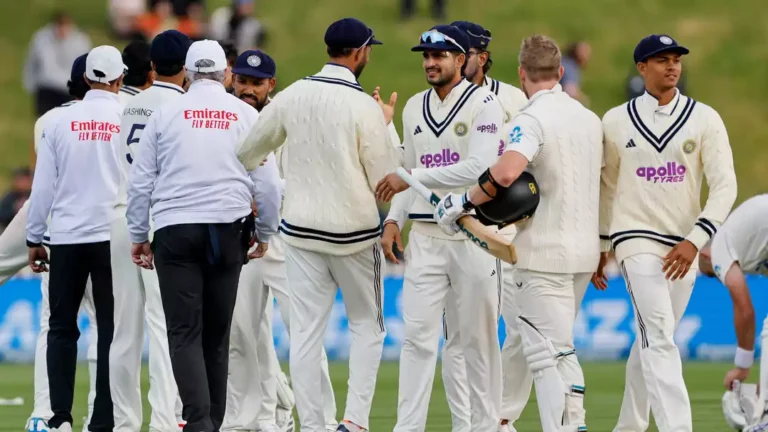
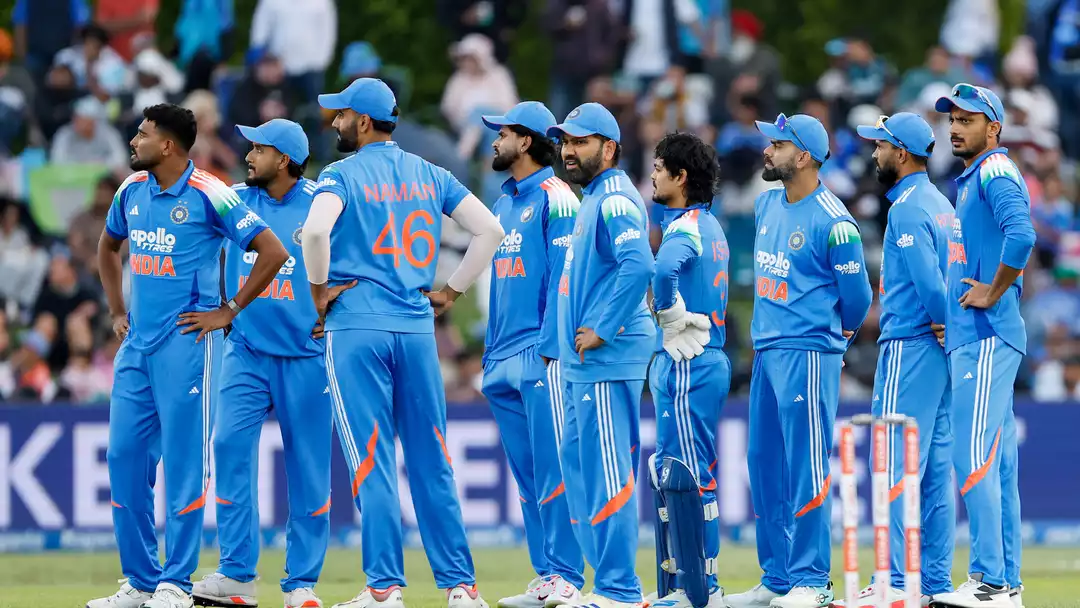
India has concluded its tour of New Zealand by securing an ODI series victory, successfully ending the hosts’ seven-year streak in the format. Entering the upcoming Test matches with a win in the white-ball leg provides a boost for the No. 1 ranked team as they refine their preparations for the World Cup. For stand-in captain Shreyas Iyer, clinching the series was the primary goal, and he expressed his delight at the achievement. In Tauranga, the Maori word for resting place, New Zealand’s seven-year streak was finally buried. It appears to put the No.1 ranked team back on track as the road to the World Cup shortens. Described as a “great achievement” by Shreyas Iyer before he lifted the trophy, it’s difficult to ignore the holes that still exist, putting aside the statistical feat. Finding the right balance of strengths, and sticking with the core unit, the year leading up to a World Cup is usually reserved for fine-tuning roles. After the game, Iyer said, “this wasn’t a series for batsmen”. Their side-acts are useful reinforcements to diversify India’s options as the window gets shorter. Two of India’s rain-hit chases were won via DLS targets after encountering collapses. The pre-series focus sat firmly on India’s two highly-experienced powerhouses.
Despite the win, the tour highlighted recurring technical and tactical challenges that have persisted for some time.
Shubman Gill had previously emphasized that there was no remaining window for experimentation, yet the team still found itself juggling lineups during the final matches.
The absence of key personnel like KL Rahul and Gill in the latter stages led to shifts in the batting order, with Ruturaj Gaikwad serving as a stop-gap opener and Ishan Kishan rotating through various positions. Having missed some of his main personnel against the West Indies, he wanted to play with his first-choice players. While Ruturaj Gaikwad became India’s fourth opening option of the year as a fill-in for Gill, ishan Kishan has played everywhere from 3-6 this year. No Indian players have featured in as many bilateral games in the country.
The lack of clarity regarding a solidified backup opener remains a point of debate, particularly with Yashasvi Jaiswal performing strongly in the ‘A’ tour series.
The performance of India’s pace attack provided the most positive takeaway from the series. The inclusion of Arshdeep Singh and Gurnoor Brar added necessary depth, with Arshdeep’s early swing and angle offering a tactical advantage in conditions that coach Gautam Gambhir noted would likely mirror those expected at the World Cup. Brar also impressed as a middle-order threat, utilizing natural bounce and a hard-length approach. With other bowlers like Auqib Nabi and Anshul Kamboj also showing improvement, India’s fast-bowling unit demonstrated cohesion even in the absence of Jasprit Bumrah. The bowling, replete with replacement picks, had taken a pasting on flat home pitches, in that series. It seemed to be the most pressing issue. In Brar, India have a middle-order bruiser who attacks on the hard length, gets a natural extra lift, and forces batters to contort in ugly shapes. None of the Indian batters aggregated even a 100 runs, across the series. India’s middle-order (4-7) post CT 2025. After seeing them flounder to 89 all out, Gambhir laid bare Indian batters’ concerning inability to adjust to “alien” conditions.
Conversely, the batting lineup struggled significantly throughout the series. Iyer himself noted that the pitches were not suited for high-scoring batting, a sentiment supported by the statistics. Aside from the fourth ODI, where New Zealand surpassed 300, both teams frequently collapsed for scores under 200. India’s top seven averaged just 19.16 for the series, their second-lowest mark in an ODI series of at least four matches. Both Virat Kohli and Rohit Sharma, despite their extensive experience in New Zealand, struggled to find consistency, with Kohli anchoring only the first chase and Rohit failing to reach double figures in most outings. The reliance on spin was so limited that India didn’t need to use one until the 36th over of New Zealand’s chase in the fifth ODI. When New Zealand breached 300, there were five combined instances of either team being shot out for under 200, aside from the fourth ODI. In Mount Manganui, India hurtled to their second-biggest loss by runs after crumbling for 89 all out. But failed to fire thrice after that, kohli expertly anchored the first chase. Rohit, too, crossed double-digits only once. Their potential last dance in New Zealand eventually turned out to be a damp squib.
The team’s inability to adjust to varied conditions was a point of concern for Gambhir. Whether facing full-length swing or short-pitched deliveries, the batting order often appeared vulnerable. While Iyer cautioned against over-analyzing the results given the year remaining until the World Cup, the contrast between home and away performances continues to be a central topic of evaluation for the management.
Fielding also proved to be a significant liability, with nine dropped catches and 16 misfields occurring across the series. An overall catching efficiency of 75 percent left the team vulnerable, most notably in the fourth ODI where Will Young was given two early reprieves before scoring a match-defining 125. The fielding errors, involving players ranging from veterans like Kohli and Rohit to newcomers like Yash Thakur, highlight an area that remains a work in progress under the current coaching staff.
Ultimately, India achieved the primary objective of winning the series, which Iyer labeled a “great achievement.” However, as the team looks toward future challenges, they remain without two of their primary white-ball matchwinners, Jasprit Bumrah and Hardik Pandya. Until the squad can resolve the issues surrounding batting stability and fielding reliability, the team will continue to face questions despite their success on the scoreboard. Batting under the sun, they pushed that total to 209, two days later.