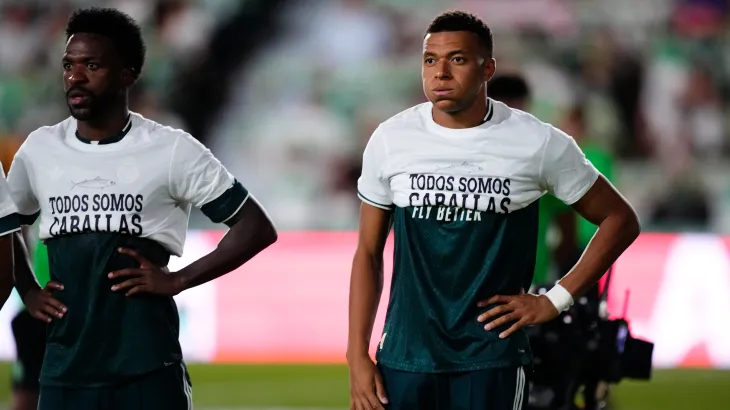
Real Madrid players Kylian Mbappe, Vinicius Junior, and Ibrahima Konate have drawn significant attention after appearing to partially hide a solidarity message on their pre-match shirts. During their La Liga fixture against Elche at the Manuel Martinez Valero Stadium on Tuesday, both squads arrived on the pitch wearing white jerseys featuring the slogan “Todos somos caballas,” which translates to “We are all mackerels,” a term referencing local residents of the Spanish enclave of Ceuta.
Video footage from the event captured Mbappe, Vinicius Jr, and Konate rolling up their white shirts to their chests while waiting to step onto the field, effectively obscuring portions of the text before the garments were removed during the pre-match handshakes. While the initiative was organized by both clubs to show support for the city, the trio’s decision to modify the shirts sparked a polarized reaction on social media. Supporters of the gesture praised the players for wearing the shirts at all, while critics questioned their commitment to the public statement.
This incident occurs amidst heightened political sensitivity regarding Ceuta, a Spanish autonomous city on the North African coast that has become a flashpoint for migration. Over July 30 and 31, more than 70,000 individuals crossed from Morocco into the enclave in a surge that resulted in multiple casualties. While thousands have since returned, several thousand remain in the city, which is heavily fortified with border fences and continuous surveillance by Spanish law enforcement.
FIFA regulations under Rule 4.5 prohibit players from displaying political, religious, or personal slogans on their kit or undergarments. However, enforcing these rules remains complex, and footballers often evade formal sanctions for such expressions. When questioned about potential disciplinary action, football’s governing body noted that any penalties would fall under the jurisdiction of La Liga, the Royal Spanish Football Federation (RFEF), and UEFA. To date, none of these organizations have responded to requests for comment regarding the incident.
The controversy follows similar displays of solidarity across the league. Earlier, Real Betis winger Abde Ezzalzouli wore the same slogan prior to a match against Villarreal. The 24-year-old, who has roots in Morocco, faced backlash from some Moroccan fans who are sensitive to the ongoing diplomatic rifts between Madrid and Rabat. In response, Ezzalzouli clarified on Instagram that the shirt was not intended as a political tool or an act of contempt toward the Moroccan people, but rather as a social gesture supporting the local population regardless of nationality.
“This is not an apology to anyone,” Ezzalzouli stated, emphasizing that he would continue to represent his heritage with pride. Amid the broader tensions, Morocco’s Ministry of Foreign Affairs recently denied any state involvement in the July border crossings. Meanwhile, the diplomatic situation remains strained, particularly as Morocco does not officially recognize Spanish sovereignty over Ceuta or the nearby territory of Melilla, viewing them instead as occupied enclaves. Looking ahead, Real Betis has scheduled a friendly match against Ceuta in Seville on October 1 to continue raising funds and demonstrating solidarity with the city’s residents. The report also notes that some commenting on social media saw the move as the players’ disregard for the issue, which has prompted solidarity protests across Spain, while others praised the trio for wearing the shirt in the first place, in a sign of how divisive the episode has become. The report also notes that rule 4.5, pertaining to players’ clothing and equipment, also bans players from revealing undergarments that show political, religious, personal slogans, statements or images, or advertising other than the manufacturer’s logo. The report also notes that “I want to make one thing clear – at no point was the shirt referring to the people of Ceuta used with a political objective or out of contempt for my people, the Moroccan people,” said Abde in an Instagram post. The report also notes that ceuta and Melilla are the only remaining European-held territories on the African mainland. The report also notes that ceuta’s location makes it one of the main entry points for people trying to reach Europe. The report also notes that surveillance systems, and a permanent deployment of Spain’s Civil Guard and National Police, the enclave is protected by high border fences.